In
Atmospheric Convection we described how rising air must expand and cool, while falling air must compress and warm. We used the equation for the
adiabatic expansion of
diatomic gases to estimate the amount by which air will cool as it rises through the atmosphere.
In a debate that took place in
the comments, one of our readers claimed that a temperature difference must always exist between the bottom and the top of an atmosphere. Air is always circulating to some degree, he said, and any air that rises must cool adiabatically. He asserted that the temperature as we ascend through the atmosphere will be related to the pressure by the equation of adiabatic expansion. In
Adiabatic Magic, however, we showed that our reader's claim violated the Second Law of Thermodynamics. Spontaneous adiabatic circulation of air in the atmosphere is impossible.
If spontaneous, adiabatic circulation is impossible, there must be some physical process that stops it from happening. Although we have proved that some such process must exist, we have not yet described the process. We will attempt to do so today.
Consider the following diagram. We have a column of air 5 km high, enclosed in a box. The temperature of the air is uniformly equal to 250 K. Because of the weight of the air, the pressure at the bottom is twice the pressure at the top. We have a balloon of air at the top, and another at the bottom. Each balloon is insulating and reflecting, so no heat passes in or out. Each balloon is flexible, so the pressure of the gas inside is always equal to the pressure outside.
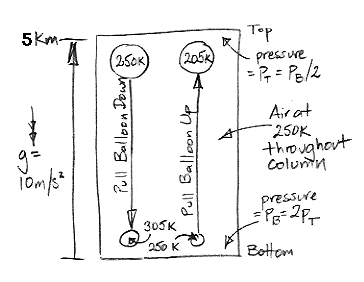
We attach a string to the upper balloon and start to pull it down. As it descends, the air around it pushes in upon it with greater pressure so as to compress its volume. The air inside undergoes adiabatic compression. Its pressure,
p, and temperature,
T, are
such that the product
p 0.4T −1.4 remains constant.
We pull the balloon all the way down to the bottom of the column. Its pressure has doubled, so its temperature must rise from 250 K to 305 K. Our balloon has grown smaller, so the surrounding atmosphere must have expanded, and therefore cooled. But suppose our column is enormous compared to the balloon, so the cooling of the air outside the balloon is negligible. The air inside is at 305 K, and that outside remains at 250 K. The density of the air outside is 305/250 = 1.2 times greater than that of the air inside. Every kilogram of air in the balloon occupies the same volume as 1.2 kg of air outside the balloon.
By the principal of
buoyancy, every kilogram of air in the balloon will experience an upward force equal to the weight of 0.2 kg of air. If we assume gravity is 10 m/s/s, we see that we must hold the balloon down with a force equal to 2 N/kg (two Newton per kilogram of air inside) or else it will rise, and it won't stop until it gets to the top again.
This buoyancy force was zero when we started pulling the balloon down, and at the end it was 2 N/kg. The average force would be close to 1 N/kg, which we apply over 5 km, so we must do roughly 5 kJ/kg of work to pull the balloon down.
Now suppose we pull the lower balloon up from the bottom at the same time. The net change in the volume of the rest of the column is is now zero, so we really can say that the outside air remains at 250 K. This other balloon, when it reaches the top of the column, will have expanded. It's pressure has halved, so its temperature must drop from 250 K to 205 K. It's density is 1.2 times greater than the air around it, so it will experience a negative buoyancy force of 2 N/kg. If we don't pull it up, it will sink all the way to the bottom again. In drawing it up, we must do 5 kJ/kg of work.
We must do 5 kJ of work to raise a single kilogram of air from the bottom to the top, and 5 kJ to lower another kilogram from the top to the bottom. Thus we see that the spontaneous circulation of air suggested by the Adiabatic Magic hypothesis is indeed impossible. It is buoyancy that stops the magic. We need a source of work to cause circulation, and no such source exists in our column of air at a uniform temperature.
One source of the necessary work is a heat engine in which we supply heat at a higher temperature to the bottom of the column and extract heat at a lower temperature from the top. Any time we have a source of heat at a higher temperature, and a place for the heat to flow to at a lower temperature, we can make a machine that does work. In the atmosphere, this machine is implemented, albeit inefficiently, by convection. We discussed
work by convection earlier, but we we will return to it in future posts.
UPDATE: I originally made the column 10 km high, but Michele pointed out that I had my math wrong. The column should be 5 km high. Indeed, it turns out that the heigh of the column for which we have half the pressure at the top is a function of temperature only, which did not occur to me until I tried to duplicate Michele's calculation. See comments for details.