Sunday, January 22, 2012

Thermal Equillibrium

An object is in thermal equilibrium when the amount of heat entering the object is equal to the amount of heat leaving it. In the case of a planetary system, consisting of a surface and atmosphere, the system will be in thermal equilibrium when the heat arriving from the Sun is, on average, equal to the heat the system radiates into space. The planetary system of our Circulating Cells program will be in thermal equilibrium when the short-wave radiation penetrating to the planet surface from the Sun is balanced by the long-wave radiation escaping into space from its surface, atmospheric gas, clouds, rain, and snow.

When our simulated system converges upon a state where the temperature of its surface and of its atmospheric layers fluctuates around some average value, our hope is that the heat penetrating to the surface from the Sun will be equal, on average, to the heat the system radiates into space. The heat penetrating from the Sun is, of course, the incoming short-wave radiation that is not reflected back into space by our simulated clouds. The heat radiated into space is the upwelling radiation at the top of our simulated atmosphere. We refer to the top of the atmosphere at its tropopause, and to the heat radiated into space as the total escaping power.

We instructed CC11 to print out the average penetrating power from the Sun and the total escaping power from the tropopause every ten hours, and plotted these values for the fourteen thousand hours of the experiment we performed in our previous post. For the final ten thousand hours, the temperature of the surface and the atmospheric layers fluctuate by ±1°C around their average values, as you can see here.


Over the final ten thousand hours, the average penetrating power is 290.0 W/m2 and the average escaping power is 289.6 W/m2. Given the size of the fluctuations in both quantities, and the errors introduced by certain simplifications in our simulation's calculations, we are well-satisfied with this agreement. Our simulation converges upon an equilibrium state that is also a state of thermal equilibrium.

Wednesday, January 18, 2012

Radiating Clouds

The latest version of Circulating Cells implements the upwelling and downwelling radiation calculations we described in Up and Down Radiation. To run the program, download CC11 and follow the instructions at the top of the code. Clouds absorb and emit long-wave radiation as if they were black bodies. We now set the transparency fraction of our atmospheric gas to 0.5, so that it will be transparent to half the wavelengths in the long-wave spectrum and opaque otherwise. The planet surface can radiate heat directly into space at these transparent wavelengths, as it did in Simulated Planet Surface. But now we have clouds doing the same thing, while at the same time reflecting sunlight back into space.

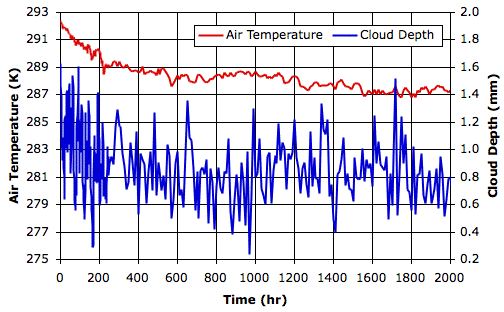
We begin our simulation with the final state of Simulated Rain, which you will find in SR_1200hr. The initial surface air temperature is 292 K, and cloud depth is 1.5 mm. The following graph shows how air temperature and cloud depth vary in the first two thousand hours.


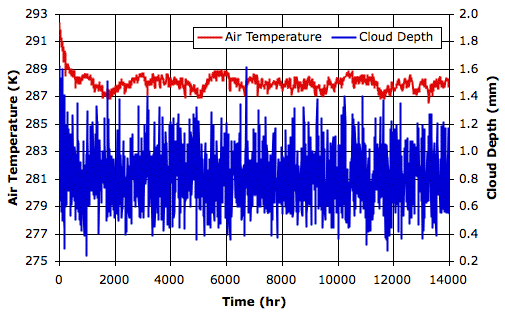
The following graph shows the first fourteen thousand hours. You will find the final state of the array in RC_14000hr. The average surface air temperature over the final ten thousand hours is 288 K, and the average cloud depth is 0.8 mm.


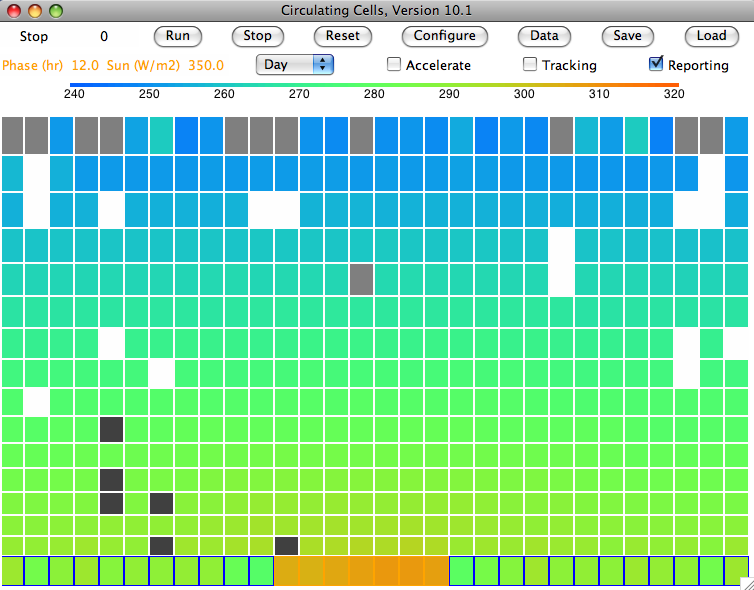
During the course of these fourteen thousand hours, the distribution of clouds in the atmosphere varies greatly. Sometimes there is a layer of clouds just above the surface of the sea. At other times there are clouds along much of the tropopause. For a view of the final state of the simulation, see here.

As we have discussed many times before, the absorption of long-wave radiation by the atmosphere gives rise to the greenhouse effect. The more opaque the atmosphere, the more heat must be radiated into space by the tropopause instead of the planet surface. In order to radiate more heat, the tropopause must be warmer. If the tropopause is warmer, the planet surface must be warmer too, in order to motivate convection to carry heat to the tropopause. When we change our atmospheric gas from 0% to 50% transparency, we expect the surface temperature drop. And indeed it does: by 4°C.

This cooling of 4°C is, however, far less than the cooling of 31°C we observed when we increased the transparency of our gas from 0% to 50% in the absence of simulated clouds. As we have already discussed, clouds and rain greatly reduce the sensitivity of surface temperature to changes in solar power. Now we find that they also greatly reduce the sensitivity of surface temperature to changes in the transparency of the atmospheric gas.

Friday, January 13, 2012

Up and Down Radiation

We are going to add to our Circulating Cells simulation the absorption and emission of long-wave radiation by clouds. As we showed earlier, a liquid water depth of 100 μm absorbs over 99% of all long-wave radiation. Rain contains liquid water also, and ice is a good absorber of long-wave radiation too. We will add the equivalent depth of snow, rain, and cloud droplets for each cell, and so obtain the depth of water within the cell that acts to absorb long-wave radiation.

We note that the same addition of rain, snow, and cloud droplets does not apply to the transmission of short-wave radiation. Water is transparent to short-wave radiation, and clouds reflect it by refracting it through millions of microscopic droplets. But rain and snow contain thousands of times fewer drops and crystals for a given depth of water, so they are thousands of times less effective at refracting sunlight.

For simplicity, we will assume the water in a cell is either transparent or opaque to long-wave radiation, but not in-between. If the combined concentration of rain, snow, and cloud droplets in a cell is greater than wc_opaque, we will assume the entire gas cell is opaque to long-wave radiation. Otherwise, the cell will absorb long-wave radiation as if it were dry, as determined by our transparency_fraction. With our 300-kg cells, a concentration of 0.33 g/kg corresponds to 100 μm of water.

Now we are faced with the possibility of multiple layers of cloud, snow, and rain, all absorbing and emitting long-wave radiation in all directions. The first simplification we make is to assume each gas cell radiates only vertically upwards and downwards. Because our columns of cells are much the same as one another on average, the net effect of this simplification will be small. Even with this simplification, we see that a cloud can absorb radiation from a cloud below, and emit radiation back to that same cloud below, and upwards to a third cloud.

We will calculate the effect of long-wave radiation in the following way. We start at the surface and allow it to radiate as a black body. We allow this upward radiation to enter the first gas cell. We calculate how much is absorbed by the cell and how much keeps going. We calculate how much power the gas cell itself radiates upwards. We add this to the existing upward radiation. We move on to the cell above, and so on, until we get to the tropopause. At the tropopause, we assume the atmosphere above is transparent to long-wave radiation, so all upward-going radiation passes out into space.

We repeat the same process, going down. We start with the tropopause gas cell in each column and move down cell by cell until we arrive at the bottom, at which point all the downward-going radiation is absorbed by the surface. We first considered this kind of downward-going long-wave radiation in our Back Radiation post. It is distinct from the solar radiation that penetrates the atmospheric clouds because it is radiation emitted by the clouds, rain, snow, and atmospheric gas themselves.

In any cell, the long-wave radiation going up is the upwelling radiation and the long-wave radiation going down is the downwelling radiation. At the tropopause, the upwelling radiation is the heat leaving our planetary system. It is our total escaping power. When our simulation converges to equilibrium, we should find that the average solar power penetrating to the surface is equal to the average total escaping power.

Monday, January 9, 2012

Sinking Restored

When we added rain and snow to our Circulating Cells program, we removed the slow descent of microscopic water droplets, saying that their movement would be insignificant compared with that caused by convection. This is indeed the case when an equilibrium with plenty of atmospheric convection is established.

Nevertheless, we have found in our recent tests, in which we are allowing the clouds to radiate heat directly into space, that clouds can form and sit directly upon the surface, where they block the Sun's light. The surface cools beneath these clouds, and the clouds themselves cool by radiating into space, and we have seen them sit there fore hundreds of hours. This is unrealistic, because in a hundred hours, a cloud will sink by at least a few hundred meters.
So we restored the sinking of cloud droplets to our simulation, at 3 mm/s, which is realistic for cloud droplets 20 μm in diameter.

When we restored the sinking, we noticed that our previous implementation had allowed the clouds to sink only when the cells containing them took part in a convection circulation. As a result, the clouds were sinking through our simulated atmosphere a hundred times slower than they should have been. The fast-sinking implemented by CC9 were in fact sinking at 3 mm/s instead of 300 mm/s, and the slow-sinking clouds were sinking at only 0.03 mm/s instead of 3 mm/s. Thus our fast-sinking clouds were a more realistic simulation of the manner in which actual clouds would sink, while our slow-sinking clouds were unrealistically slow. We run our sinking cloud experiments with a corrected version of CC9, and the new slow-sinking result looked like the former fast-sinking result.

When clouds sink at 3 mm/s, they can sit on the surface for a few hours, but after a hundred hours, they disappear. The droplets will sink 1000 m in a hundred hours, which is three times the height of a gas cells resting upon the surface. The slow descent of the droplets removes clouds that would otherwise freeze the surface, and therefore plays an important role in our simulation, despite the fact that convection, rain, and snow cause movements that are thousands of times faster.

Friday, December 23, 2011

Simulated Rain

The latest version of our Circulating Cells program implements the simplified evaporation cycle we presented in our previous post. Freezing clouds turn into snowflakes and drift downwards. When the snowflakes pass through warm air, they melt and become raindrops. To run the program, download CC10 and follow the instructions at the top of the code.

We run the simulation starting with our cold-start state, CS_0hr. The program runs ten times slower than before. The water balancing calculations are more complex now that we have added precipitation, and we must perform them more often because rain and snow move quickly through the atmosphere. Nevertheless, a few hours running gives us six weeks of simulation time, and the atmosphere converges to the equilibrium state shown below, which you will find stored in SR_1200hr. The light gray cells are clouds of water droplets. The white cells are clouds of snowflakes. The dark gray cells are rain.


We see clouds of water droplets in the top row of cells. Here they are cooling by radiation. Our atmosphere is still opaque to long-wave radiation (transparency fraction is zero). Only the top cells can radiate into space. Their temperature is, however, well below 268 K (Tf_droplets), the temperature at which droplets are transformed into ice crystals. Snow forms within the clouds at 0.001 g/kg/s (freeze_rate_gps) and falls at 1 m/s (snow_speed_mps). When it sinks through a cell warmer than 278 K (Tm_ice), it melts at 0.01 g/kg/s (melt_rate_gps), forming rain. Rain falls at 5 m/s (rain_speed_mps).

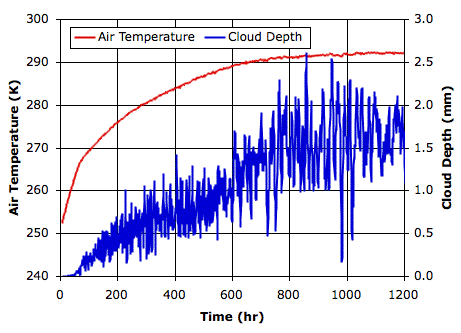
The following graph shows how surface air temperature and average cloud depth vary with time from our cold start. The final cloud depth fluctuates by ±0.5 mm around an average value of 1.7 mm. The average temperature of the surface gas is 292 K, which is 19°C. Of the light that arrives from the Sun, 30% is reflected into space, giving our simulated planet an albedo of 0.3, which matches that of our own planet Earth.


With fast-sinking clouds, the cloud depth remained close to 2.9 mm and the surface temperature was −7°C. Evaporation from water at 19°C is roughly ten times faster than from from water at −7°C, but precipitation is so effective at removing water from the atmosphere, the sky is almost entirely clear. Indeed, the Sun shines directly upon our island half the time, heating its sandy surface up to 34°C.

Monday, December 19, 2011

Evaporation Cycle

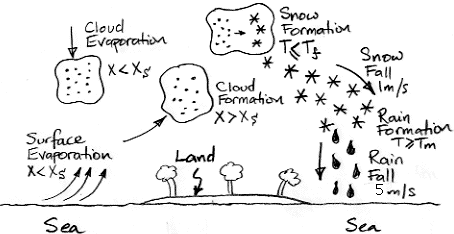
The following diagram presents the simplified cycle of evaporation and precipitation we propose to implement in Circulating Cells Version 10.1.


Evaporation takes place from the sea, as before. When a body of moist air rises, it cools, and microscopic droplets form by condensation. Clouds of such droplets that happen to descend from above will warm up, and some or all of their droplets will evaporate. A cloud of droplets whose temperature drops below some threshold Tf will be transformed into snowflakes by the Bergeron Process, warming the surrounding gas with latent heat of fusion. We choose Tf several degrees below the freezing point of water, so we can assume the freezing takes place rapidly.

In our simulation, snow will fall at an average of 1 m/s, which we base upon our own observations. We will implement snow fall in the same way we implemented sinking clouds. Snow that reaches the surface will melt and thus take its latent heat of fusion from the surface block. This melting at the surface is the simplest way we can think of to conserve the latent heat of fusion of the water involved in our evaporation cycle. We assume that our surface water itself never freezes, no matter how cold it gets.

Our clouds, meanwhile, will no longer sink. Real cloud droplets are of order ten microns in diameter and sink at a few millimeters per second. The contribution of such sinking to our new cycle would be negligible.

Snow that enters a gas cell at a temperature greater than Tm will melt, cooling the surrounding gas by absorbing its latent heat of fusion. The melted snowflakes become raindrops a few millimeters in diameter, and these fall at 5 m/s. With the simulation set up as we have it now, the cells are around 400 m high, so rain will take a minute or two to fall out of one cell into the next. We will choose Tm several degrees above the melting point of water so we can assume the melting takes place rapidly.

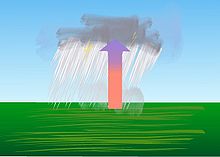
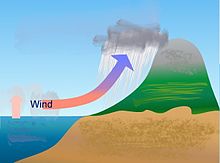
Our simplified evaporation cycle omits many interesting evaporation-related phenomena. When rain drops are carried up into cold air, for example, they form hail, which later falls to Earth. When liquid rain falls into sufficiently dry air, it evaporates and disappears altogether, giving rise to virga. When air rises at just the right speed along a mountain slope, water droplets join together to form rain drops, as in orographic precipitation. Our simulation will contain none of these interesting phenomena. But we believe it will capture the fundamental features of the Earth's evaporation cycle, and so allow us to investigate how this cycle influences the global surface temperature.

Monday, December 12, 2011

Rain

Our simulated sky never clears. Clouds fill the atmosphere almost entirely. They are forever forming in air that rises from the sea, and forever sinking to the ground, but they never come falling out of the sky all at once in the big drops we know as rain.

The droplets in our clouds are tiny. Those in our slow-sinking clouds are only 10 μm in diameter and descend at 3 mm/s. Those in our fast-sinking clouds descend at 300 mm/s. The graph we present in Falling Droplets implies that these fast-sinking droplets are 100 μm in diameter. Rain falls to Earth at several meters per second, so the same graph tells us that rain drops are at least 500 μm in diameter. A drop 500 μm in diameter contains a hundred times as much water as a droplet of 100 μm and a hundred thousand times as much water as a droplet of 10 μm. Could it be that cloud droplets collide and coalesce in order to form rain drops? If so, how long does this take, and under what circumstances does it occur?

The Wikipedia page on rain describes convective precipitation and orographic precipitation. In both these forms of rain, a cloud moves up, and encounters rain drops descending from above. If the descending drops are 500 μm in diameter, and the air is moving up at 1 m/s, the drops will remain at the same altitude. The cloud moving up and past them carries microscopic droplets that can collide with the stationary drops, coalesce with them, and so enlarge them until they are heavy enough to fall out of the rising cloud and descend to the Earth as rain.

But further reading suggests that rain formed of coalescing droplets is rare. A far more potent source of rain drops are ice crystals. In Cloud Physics, we learn of the Bergeron Process, whereby ice crystals grow, sink, melt, and become rain drops. Large rain-drops are melted hail-stones. Small rain-drops are melted snow-flakes.

In our simulation, whenever the concentration of water vapor exceeds the saturation concentration, we assume the excess water condenses. It turns out, however, that the surface tension of liquid water makes it hard for water to condense into floating, microscopic droplets. If we provide a solid surface for the water to condense against, such as a blade of grass or a glass mirror, the water will condense when it reaches the saturation concentration, but in a body of air high above the ground, the only such surfaces would be dust particles, and these may be rare. Each one will serve as a catalyst for condensation until a droplet forms around it.

But the same is not true of ice crystals. In air saturated with water vapor and below the freezing point of water, an ice crystal can form on a grain of dust, and after that it will continue to grow. Water vapor deposits directly upon the surface of the crystal, thus changing state from gas to solid in one step, and the newly-created ice surface is an ideal foundation for further growth.

Now, suppose a cloud of microscopic water droplets rises until its temperature drops to −20°C. We might assume that the droplets will freeze. But pure water droplets resist freezing until they drop to −40°C. Ice crystals form in the midst of the cloud of super-cooled water droplets. As water vapor is deposited on the crystals, the concentration of water vapor in the air drops.

And here we encounter another curious physical phenomenon. The saturation concentration of water vapor with respect to an ice crystal turns out to be lower than the saturation concentration of water vapor with respect to super-cooled liquid water. Water vapor will deposit on the ice crystals until the concentration of water vapor drops to the saturation concentration of water vapor with respect to ice crystals. Because this concentration is below the saturation concentration with respect to super-cooled liquid water, the water droplets actually start to evaporate. The droplets evaporate, and their water is deposited onto larger and larger ice crystals.

Once the ice crystals are large enough, they start to fall, and they eventually fall into air that is warm enough to melt them. They turn into drops of water and fall to Earth as rain. It is this process that we will attempt to simulate in the next version of our Circulating Cells program.