In our previous post, we presented our simulation of clouds without rain. We started the atmospheric gas, the sandy island, and the watery sea, at a uniform 280 K (7°C). Water evaporated from the sea. The sand heated up in the sun. Hot air rose above the island and sucked moist air in from the sea. Clouds formed above the island, spread through the atmosphere, reflected the heat of the sun, and the world froze.
What if we start with a frozen world and a dry atmosphere? In our simulation of evaporation rate, no water will evaporate from a sea at 250 K (−23°C), so no clouds will form. We ran CC9, starting with the CS_0hr array, to find out what would happen. Our starting point is a uniform 250 K with no water vapor. We run with 350 W/m2 continuous heat from the Sun.
After 20 hrs, the sandy island has warmed to 276 K (3°C). At 30 hrs, the average cloud depth is 0.03 mm, which is so thin that we don't bother plotting the clouds as white cells. But at 40 hrs we start to see the first thin clouds, and the average power arriving from the Sun drops to 335 W/m2. At 50 hrs, the island reaches 283 K (10°C). From here on, it cools. At 100 hrs, the average cloud depth is 3.5 mm and only 120 W/m2 is arriving from the Sun. The sea reaches 267 K (−6°C), which is the warmest it will ever get. By 200 hrs, cloud depth is 7.2 mm and power arriving from the Sun is only 40 W/m2, as recored in CS_200hr.
We can see where the simulation is going to end up: a world kept frozen by immortal clouds. Regardless of our starting point, immortal clouds reflect the Sun's heat and cause the world to freeze.
Wednesday, October 19, 2011


Tuesday, October 4, 2011
Clouds Without Rain
Today we present Circulating Cells Version 9 (CC9), and we use it to find out what would happen if we had clouds without rain. The simulation implements the following features of clouds.
(1) Evaporation from surface water, as in Evaporation Rate.
(2) Condensation in rising air, as in Condensation Point and Condensation Rate.
(3) Cooling and warming by latent heat of evaporation, as in Latent Heat.
(4) Reflection of incoming sunlight, as in Simulated Clouds, Part I.
The simulation does not yet implement the following features of clouds.
(5) Absorption and emission of long-wave radiation, as in Simulated Clouds, Part II.
(6) Cooling and warming by latent heat of fusion, as in Latent Heat.
(7) Rain and snow.
If we set the simulated atmosphere's transparency fraction to 0.0, we make the atmospheric gas opaque to long-wave radiation. No radiation escapes into space from the surface blocks nor from the rows of gas cells below the top row, regardless of the distribution of clouds within the atmosphere. The top row of cells, which is our simulated tropopause, does all the radiating of heat into space. Although this opaque atmosphere is not realistic, it does mask the fact that our clouds do not in themselves absorb or emit long-wave radiation, allowing us to proceed with a simulation that is at least self-consistent. Thus the copy of CC9 that you can download today has the transparency fraction set to 0.0 by default.
We ignore the warming of rising air by freezing water droplets, and the cooling of falling air by melting ice crystals. We will add ice crystals to our simulation later. For now, we trust that the error caused by our omission is not so great as to overturn the observations we make today.
By ignoring rain and snow, we are ignoring a feature of clouds that is so important to our climate that our simulation produces an entirely fantastic result. To watch the simulation in action, download CC9 and follow the instructions at the top of the code to run the program on your computer. Get the CWR_0hr array file and load it with the Load button. You will see an atmosphere at a uniform 280 K, and down at the bottom, an island of sand in a sea of water, also at 280 K. Press Run and the simulation will begin. The CC9 code runs in "Day" mode by default, with 350 W/m2 arriving continuously from the sun.
Without rain and snow, any and all moisture that enters the atmosphere at the beginning of the simulation remains in the atmosphere for as long as the simulation runs. There is no means by which moisture can return to the surface of the planet. So long as the lower atmosphere is warm enough to absorb water vapor, however, the clouds can appear and disappear. The moisture they contain can either take the form of water vapor, as it will when the surrounding gas is warm, or it can take the form of water droplets, as it will when the surrounding gas is cold.
We represent clouds in our simulation with cells that are shaded white to gray. The thinnest clouds are white and the thickest are black. A cloud with 1 mm of water is white. A cloud with 12 mm of water is black. After 30 hours, the first white clouds appear over the island, the result of moist air from the sea being heated by the island and rising towards the tropopause. When it rises, it cools, and water vapor condenses to form the first clouds.
At 40 hours, the island reaches its peak temperature of around 311 K. After that, the clouds become more numerous. They reflect the Sun's light back into space. The surface begins to cool. After 150 hrs we end up with the following display.
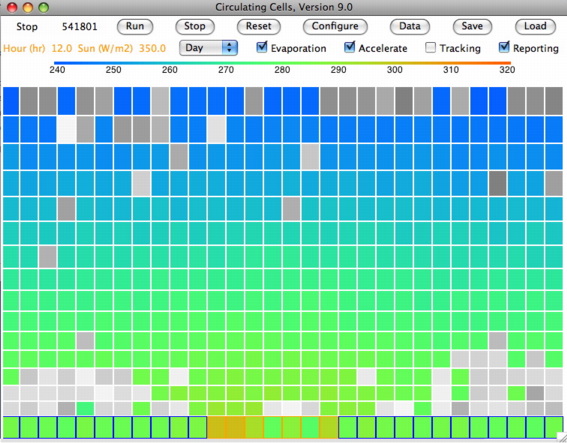
There is fog over the sea and part of the island. There are thick clouds up in the tropopause. The average heat arriving at the surface from the Sun has dropped from 350 W/m2 to only 50 W/m2. The following graph shows how the atmosphere cools in the first 500 hrs.
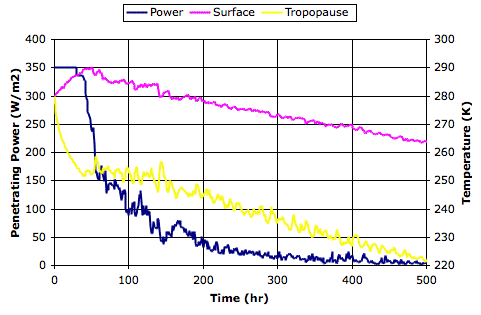
Let us refer to the combined thickness of the clouds above a surface block as is its cloud cover. In our simulation, each 3 mm of cloud cover reflects 63% of incoming sunlight. If we press the Data button, a text window opens and here we will see a line of numbers printed every hour of simulation time. The first number is the time in hours, the second is the average cloud cover in millimeters. The third number is the average sunlight power penetrating to the surface through the cloud cover in Watt per square meter. After that we have four temperatures in Kelvin: average sand temperature, average water temperature, average surface gas temperature, and average tropopause temperature. We used these printed lines to obtain the data for the plot above.
After 3000 hrs, the tropopause has dropped to 158 K (−115°C) and the surface air is at 184 K (−85°C). The average cloud cover is 25 mm. Only 0.7 W/m2 arrives at the surface. You can see this for yourself by loading CWR_3000hr into the simulation. Even at 158 K, the tropopause is still radiating 35 W/m2, which is far more than the 0.7 W/m2 reaching the planet surface. The tropopause will keep cooling until it reaches 60 K, at which point it will be radiating 0.7 W/m2. Of course, at that point, nitrogen will condense into liquid.
If clouds remained aloft in the atmosphere indefinitely, the Earth would freeze. But in reality, clouds are forever falling towards the ground. They are made of droplets and crystals that are heavier than air. Rain and snow are what stop clouds from turning the Earth into a planet of frozen seas.
(1) Evaporation from surface water, as in Evaporation Rate.
(2) Condensation in rising air, as in Condensation Point and Condensation Rate.
(3) Cooling and warming by latent heat of evaporation, as in Latent Heat.
(4) Reflection of incoming sunlight, as in Simulated Clouds, Part I.
The simulation does not yet implement the following features of clouds.
(5) Absorption and emission of long-wave radiation, as in Simulated Clouds, Part II.
(6) Cooling and warming by latent heat of fusion, as in Latent Heat.
(7) Rain and snow.
If we set the simulated atmosphere's transparency fraction to 0.0, we make the atmospheric gas opaque to long-wave radiation. No radiation escapes into space from the surface blocks nor from the rows of gas cells below the top row, regardless of the distribution of clouds within the atmosphere. The top row of cells, which is our simulated tropopause, does all the radiating of heat into space. Although this opaque atmosphere is not realistic, it does mask the fact that our clouds do not in themselves absorb or emit long-wave radiation, allowing us to proceed with a simulation that is at least self-consistent. Thus the copy of CC9 that you can download today has the transparency fraction set to 0.0 by default.
We ignore the warming of rising air by freezing water droplets, and the cooling of falling air by melting ice crystals. We will add ice crystals to our simulation later. For now, we trust that the error caused by our omission is not so great as to overturn the observations we make today.
By ignoring rain and snow, we are ignoring a feature of clouds that is so important to our climate that our simulation produces an entirely fantastic result. To watch the simulation in action, download CC9 and follow the instructions at the top of the code to run the program on your computer. Get the CWR_0hr array file and load it with the Load button. You will see an atmosphere at a uniform 280 K, and down at the bottom, an island of sand in a sea of water, also at 280 K. Press Run and the simulation will begin. The CC9 code runs in "Day" mode by default, with 350 W/m2 arriving continuously from the sun.
Without rain and snow, any and all moisture that enters the atmosphere at the beginning of the simulation remains in the atmosphere for as long as the simulation runs. There is no means by which moisture can return to the surface of the planet. So long as the lower atmosphere is warm enough to absorb water vapor, however, the clouds can appear and disappear. The moisture they contain can either take the form of water vapor, as it will when the surrounding gas is warm, or it can take the form of water droplets, as it will when the surrounding gas is cold.
We represent clouds in our simulation with cells that are shaded white to gray. The thinnest clouds are white and the thickest are black. A cloud with 1 mm of water is white. A cloud with 12 mm of water is black. After 30 hours, the first white clouds appear over the island, the result of moist air from the sea being heated by the island and rising towards the tropopause. When it rises, it cools, and water vapor condenses to form the first clouds.
At 40 hours, the island reaches its peak temperature of around 311 K. After that, the clouds become more numerous. They reflect the Sun's light back into space. The surface begins to cool. After 150 hrs we end up with the following display.
There is fog over the sea and part of the island. There are thick clouds up in the tropopause. The average heat arriving at the surface from the Sun has dropped from 350 W/m2 to only 50 W/m2. The following graph shows how the atmosphere cools in the first 500 hrs.
Let us refer to the combined thickness of the clouds above a surface block as is its cloud cover. In our simulation, each 3 mm of cloud cover reflects 63% of incoming sunlight. If we press the Data button, a text window opens and here we will see a line of numbers printed every hour of simulation time. The first number is the time in hours, the second is the average cloud cover in millimeters. The third number is the average sunlight power penetrating to the surface through the cloud cover in Watt per square meter. After that we have four temperatures in Kelvin: average sand temperature, average water temperature, average surface gas temperature, and average tropopause temperature. We used these printed lines to obtain the data for the plot above.
After 3000 hrs, the tropopause has dropped to 158 K (−115°C) and the surface air is at 184 K (−85°C). The average cloud cover is 25 mm. Only 0.7 W/m2 arrives at the surface. You can see this for yourself by loading CWR_3000hr into the simulation. Even at 158 K, the tropopause is still radiating 35 W/m2, which is far more than the 0.7 W/m2 reaching the planet surface. The tropopause will keep cooling until it reaches 60 K, at which point it will be radiating 0.7 W/m2. Of course, at that point, nitrogen will condense into liquid.
If clouds remained aloft in the atmosphere indefinitely, the Earth would freeze. But in reality, clouds are forever falling towards the ground. They are made of droplets and crystals that are heavier than air. Rain and snow are what stop clouds from turning the Earth into a planet of frozen seas.
Tuesday, September 27, 2011
Summary to Date
Once we were satisfied that our simulation handled convection properly, that we could relate the program iterations to the passage of time, and that all the heat entering the simulated system was accounted for by radiation from the top, we added blocks of either water or sand beneath the bottom gas cells, so as to simulate the planet surface. In Back Radiation we showed how the heat capacity and radiation produced by a semi-transparent atmosphere keeps the planet surface warm at night. In Island Inversion we see the surface of an island heating up ten times more than the surrounding ocean, while at night a layer of air a few hundred meters above the island is warmer, rather than cooler, than the air resting upon the island. Thus we see our simulation is consistent with our observations of surface cooling, including even temperature inversion.
Well-satisfied with our simulation of a dry atmosphere, we now turn to the simulation of a wet atmosphere, in which evaporation will cool the ocean and lead to the formation of clouds. To simulate cloud formation, we must have equations for the rate of evaporation from a water surface, the rate at which water vapor will condense out of rising air, the rate at which it will evaporate again in falling air, the cooling effect of evaporation upon the water surface, the warming effect of condensation upon the rising air, the amount of sunlight that will be reflected by existing clouds, and the amount of long-wave radiation that these same clouds will absorb and radiate. We obtained these relations in a series of posts Evaporation Rate to Consensation Rate. We have yet to consider the downward drift of water droplets that leads to their combining together and forming rain. But after so many posts of mathematics and empirical relations, we thought it was time to get back to the simulation, and so we will start our simulation of clouds without allowing rain, and perhaps we will see how important rain is for our climate.
We are running CC9 right now, and will present it later this week, once I have made a reasonable effort to eliminate errors from my implementation of evaporation, condensation, and reflection. The clouds are going round right now, as gray-shaded cells, and the effect is entertaining. Ultimately, you may recall, our objective is to see how a change in the transparency of the dry atmosphere affects the surface temperature of the planet, so that we can determine the effect of CO2 doubling within a system dominated by the effect of cloud formation and rain.
Well-satisfied with our simulation of a dry atmosphere, we now turn to the simulation of a wet atmosphere, in which evaporation will cool the ocean and lead to the formation of clouds. To simulate cloud formation, we must have equations for the rate of evaporation from a water surface, the rate at which water vapor will condense out of rising air, the rate at which it will evaporate again in falling air, the cooling effect of evaporation upon the water surface, the warming effect of condensation upon the rising air, the amount of sunlight that will be reflected by existing clouds, and the amount of long-wave radiation that these same clouds will absorb and radiate. We obtained these relations in a series of posts Evaporation Rate to Consensation Rate. We have yet to consider the downward drift of water droplets that leads to their combining together and forming rain. But after so many posts of mathematics and empirical relations, we thought it was time to get back to the simulation, and so we will start our simulation of clouds without allowing rain, and perhaps we will see how important rain is for our climate.
We are running CC9 right now, and will present it later this week, once I have made a reasonable effort to eliminate errors from my implementation of evaporation, condensation, and reflection. The clouds are going round right now, as gray-shaded cells, and the effect is entertaining. Ultimately, you may recall, our objective is to see how a change in the transparency of the dry atmosphere affects the surface temperature of the planet, so that we can determine the effect of CO2 doubling within a system dominated by the effect of cloud formation and rain.
Friday, September 23, 2011
Condensation Rate
in Condensation Point we considered the temperature at which water vapor will begin to condense into water droplets, thus making a cloud. We did not consider how fast this condensation will take place. Consider air with 20 g/kg of water vapor (that's 20 g of water vapor mixed with each 1 kg of dry air to make 1.020 kg of moist air). This air rises rapidly, expands, and cools to a point where its saturation concentration of water vapor is only 10 g/kg. Does the excess 10 g/kg condense into droplets immediately, or does it take some time, in the same way that the original evaporation took time?
As we saw in Latent Heat, the evaporation of water requires 2.2 kJ of heat for each gram of evaporating water. Because we must put energy into the water to make it evaporate, evaporation takes place slowly. In the case of condensation, however, the exact opposite is the case: condensation liberates 2.2 kJ of heat for each gram of water that condenses. Condensation takes place much more quickly, but it cannot take place instantly. In order for condensation to take place, water vapor molecules must bump into one another and stick together. A dust particle helps accelerate the condensation process by providing a surface upon which water molecules can condense. Until such time as all condensation is complete, the water vapor concentration remains greater than the saturation concentration, and we say the water vapor is supersaturated.
The cloud chambers of early high energy physics experiments used supersaturated water vapor to detect charged sub-atomic particles. A cloud chamber consists of a piston with a glass top. We fill the piston with moist air and pull the piston down rapidly, so that the air cools by adiabatic expansion and becomes supersaturated. When a charged particle, such as a cosmic ray, passes through the chamber, water condenses into a trail along its path. Indeed, cosmic rays may play a part in promoting cloud formation in our atmosphere. The CLOUD experiment is an effort by high energy physicists to apply their experience with cloud chambers to the study of cosmic rays and cloud formation, especially cloud formation at high altitudes where the air is thin and the water vapor is scarce.
Even in a cloud chamber, however, supersaturated water vapor does not endure for long. A useful cloud chamber has a piston going up and down several times a second because the water vapor condenses on its own within a fraction of a second. In our Circulating Cells program, we will check the water vapor concentration of the cells every hundred seconds or so. For the purpose of our simulation, therefore, we will assume that condensation within a cell is complete within a hundred seconds. When we find a cell with 20 g/kg of water vapor and a saturation concentration of 10 g/kg, we will allow 10 g/kg to condense into droplets.
Not only do we expect to encounter moist air rising and cooling, we will also have cloudy air falling and warming. As it warms, the saturation concentration increases, so it is possible for some or all of the water in the droplets to evaporate again. Because evaporation rate is proportional to the surface area of water, the tiny droplets of a cloud will evaporate quickly. The 20-μm diameter droplets of a cloud provide 3000 cm2 of surface area for each gram of water they contain. A 1-cm deep puddle, meanwhile, provides only 1 cm2/g. We expect cloud droplets to evaporate three thousand times more quickly than a 1-cm deep puddle. A 1-cm deep puddle will evaporate in less than ten thousand seconds, so a cloud will evaporate in less than thirty seconds. For the purpose of our simulation, therefore, we will assume that the evaporation of cloud droplets is complete within a hundred seconds.
Combining these two assumptions together, we see that whenever our simulation encounters a gas cell with water vapor concentration greater than the saturation concentration, we will remove the excess water vapor and turn it into cloud droplets. Conversely, whenever we have cloud droplets with water vapor concentration less than the saturation concentration, we will remove however many cloud droplets we can until the water vapor concentration is again equal to the saturation concentration.
As we saw in Latent Heat, the evaporation of water requires 2.2 kJ of heat for each gram of evaporating water. Because we must put energy into the water to make it evaporate, evaporation takes place slowly. In the case of condensation, however, the exact opposite is the case: condensation liberates 2.2 kJ of heat for each gram of water that condenses. Condensation takes place much more quickly, but it cannot take place instantly. In order for condensation to take place, water vapor molecules must bump into one another and stick together. A dust particle helps accelerate the condensation process by providing a surface upon which water molecules can condense. Until such time as all condensation is complete, the water vapor concentration remains greater than the saturation concentration, and we say the water vapor is supersaturated.
The cloud chambers of early high energy physics experiments used supersaturated water vapor to detect charged sub-atomic particles. A cloud chamber consists of a piston with a glass top. We fill the piston with moist air and pull the piston down rapidly, so that the air cools by adiabatic expansion and becomes supersaturated. When a charged particle, such as a cosmic ray, passes through the chamber, water condenses into a trail along its path. Indeed, cosmic rays may play a part in promoting cloud formation in our atmosphere. The CLOUD experiment is an effort by high energy physicists to apply their experience with cloud chambers to the study of cosmic rays and cloud formation, especially cloud formation at high altitudes where the air is thin and the water vapor is scarce.
Even in a cloud chamber, however, supersaturated water vapor does not endure for long. A useful cloud chamber has a piston going up and down several times a second because the water vapor condenses on its own within a fraction of a second. In our Circulating Cells program, we will check the water vapor concentration of the cells every hundred seconds or so. For the purpose of our simulation, therefore, we will assume that condensation within a cell is complete within a hundred seconds. When we find a cell with 20 g/kg of water vapor and a saturation concentration of 10 g/kg, we will allow 10 g/kg to condense into droplets.
Not only do we expect to encounter moist air rising and cooling, we will also have cloudy air falling and warming. As it warms, the saturation concentration increases, so it is possible for some or all of the water in the droplets to evaporate again. Because evaporation rate is proportional to the surface area of water, the tiny droplets of a cloud will evaporate quickly. The 20-μm diameter droplets of a cloud provide 3000 cm2 of surface area for each gram of water they contain. A 1-cm deep puddle, meanwhile, provides only 1 cm2/g. We expect cloud droplets to evaporate three thousand times more quickly than a 1-cm deep puddle. A 1-cm deep puddle will evaporate in less than ten thousand seconds, so a cloud will evaporate in less than thirty seconds. For the purpose of our simulation, therefore, we will assume that the evaporation of cloud droplets is complete within a hundred seconds.
Combining these two assumptions together, we see that whenever our simulation encounters a gas cell with water vapor concentration greater than the saturation concentration, we will remove the excess water vapor and turn it into cloud droplets. Conversely, whenever we have cloud droplets with water vapor concentration less than the saturation concentration, we will remove however many cloud droplets we can until the water vapor concentration is again equal to the saturation concentration.
Friday, September 16, 2011
Simulated Clouds, Part II
In Part 1, we gauged the thickness of a cloud by how deep a layer of water it would make if we combined all its water droplets into a pool of the same area as the cloud. A thin cloud might contain 1 mm of water, while a thick storm cloud might contain 100 mm.
We also concluded that even the thinnest of clouds is opaque to long-wave radiation, and therefore a good radiator of its own heat. Meanwhile, clouds do not absorb short-wave radiation from the sun at all because water is transparent to sunlight. Instead, they reflect sunlight back into space. For the purpose of our Circulating Cells simulation, we decided that each 330 μm thickness of water will reflect 10% of sunlight. Perhaps that's too much reflection, perhaps it's too little. We can adjust the 10% reflection depth later if we need to.
Suppose we have a 1-mm cloud layer up near the tropopause, and a 10-mm cloud layer nearer the ground. The combined thickness of both clouds is 11 mm, from which we deduce that only 3% of sunlight will penetrate to the planet surface. This is a calculation we can perform easily in our simulation. We add the thickness of the clouds above each surface block, and apply our formula for reflection to obtain the fraction of sunlight arriving at the surface.
More complicated than the incoming sunlight is the absorption and radiation of heat by separate cloud layers. The surface radiates heat as if it were a black body, but our simulated atmospheric gas has a transparency fraction, which tells us the fraction of long-wave radiation passing through the gas. The rest of the radiation is absorbed. Suppose our transparency fraction is 60%, then 60% of the heat radiated by the surface will reach the bottom layer of cloud, where all of it is absorbed. The cloud itself radiates heat in proportion to the fourth power of its temperature, as if it were a black body, and of this heat 40% is absorbed immediately by the gas above, below, and even at the center of the cloud. The remaining 60% passes down to the surface and up to the upper layer of cloud. The upper layer of cloud absorbs all the radiation from below, and itself radiates heat in proportion to the fourth power of its temperature, as if it were a black body. Of the heat radiated by the upper cloud, 60% will pass back down to the bottom layer of cloud and out into space.
Thus we see that we have long-wave radiation flowing in both directions because of the clouds. If we had just one, thick, cloud layer, our calculation would be simpler. But we have fifteen rows of cells in our simulation, so we could have seven layers of cloud, each separated by a row of gas cells. Our way of handling this problem will be as follows.
For each column of cells, we start at the top and make our way down to the surface. When we encounter a cloud, we calculate how much heat it radiates downwards from its bottom surface. We proceed until we reach another cloud, and here we allow the downward heat to be absorbed at the top surface of the cloud. We continue to the bottom surface of the cloud, and keep going with the same procedure until we get to the surface. By this time we have added up the total cloud thickness and we can determine how much sunlight has reached the surface as well.
Now we start from the surface and go upwards. The surface radiates heat, and this is absorbed by the bottom surface of the lowest cloud. The top surface of this cloud radiates heat upwards. If there is another cloud above, its bottom surface will absorb the upward-going heat, but if there is no other cloud, the heat passes into space.
During this entire process, we keep track of the amount of heat that is added or subtracted from the surface and from each gas cell. Once we are done, we adjust their temperatures to account for the heat lost or gained.
Thus we see that our clouds will introduce new sources of radiation into space that are at a lower altitude than the tropopause that is currently doing all the radiating into space of our simulated atmosphere. On the other hand, the clouds obscure the hottest radiating surface of all, which is the ground.
Our calculation of up-welling and down-welling radiation might slow down our simulation a great deal. But we're not in any hurry, so we won't worry about the computation time.
We also concluded that even the thinnest of clouds is opaque to long-wave radiation, and therefore a good radiator of its own heat. Meanwhile, clouds do not absorb short-wave radiation from the sun at all because water is transparent to sunlight. Instead, they reflect sunlight back into space. For the purpose of our Circulating Cells simulation, we decided that each 330 μm thickness of water will reflect 10% of sunlight. Perhaps that's too much reflection, perhaps it's too little. We can adjust the 10% reflection depth later if we need to.
Suppose we have a 1-mm cloud layer up near the tropopause, and a 10-mm cloud layer nearer the ground. The combined thickness of both clouds is 11 mm, from which we deduce that only 3% of sunlight will penetrate to the planet surface. This is a calculation we can perform easily in our simulation. We add the thickness of the clouds above each surface block, and apply our formula for reflection to obtain the fraction of sunlight arriving at the surface.
More complicated than the incoming sunlight is the absorption and radiation of heat by separate cloud layers. The surface radiates heat as if it were a black body, but our simulated atmospheric gas has a transparency fraction, which tells us the fraction of long-wave radiation passing through the gas. The rest of the radiation is absorbed. Suppose our transparency fraction is 60%, then 60% of the heat radiated by the surface will reach the bottom layer of cloud, where all of it is absorbed. The cloud itself radiates heat in proportion to the fourth power of its temperature, as if it were a black body, and of this heat 40% is absorbed immediately by the gas above, below, and even at the center of the cloud. The remaining 60% passes down to the surface and up to the upper layer of cloud. The upper layer of cloud absorbs all the radiation from below, and itself radiates heat in proportion to the fourth power of its temperature, as if it were a black body. Of the heat radiated by the upper cloud, 60% will pass back down to the bottom layer of cloud and out into space.
Thus we see that we have long-wave radiation flowing in both directions because of the clouds. If we had just one, thick, cloud layer, our calculation would be simpler. But we have fifteen rows of cells in our simulation, so we could have seven layers of cloud, each separated by a row of gas cells. Our way of handling this problem will be as follows.
For each column of cells, we start at the top and make our way down to the surface. When we encounter a cloud, we calculate how much heat it radiates downwards from its bottom surface. We proceed until we reach another cloud, and here we allow the downward heat to be absorbed at the top surface of the cloud. We continue to the bottom surface of the cloud, and keep going with the same procedure until we get to the surface. By this time we have added up the total cloud thickness and we can determine how much sunlight has reached the surface as well.
Now we start from the surface and go upwards. The surface radiates heat, and this is absorbed by the bottom surface of the lowest cloud. The top surface of this cloud radiates heat upwards. If there is another cloud above, its bottom surface will absorb the upward-going heat, but if there is no other cloud, the heat passes into space.
During this entire process, we keep track of the amount of heat that is added or subtracted from the surface and from each gas cell. Once we are done, we adjust their temperatures to account for the heat lost or gained.
Thus we see that our clouds will introduce new sources of radiation into space that are at a lower altitude than the tropopause that is currently doing all the radiating into space of our simulated atmosphere. On the other hand, the clouds obscure the hottest radiating surface of all, which is the ground.
Our calculation of up-welling and down-welling radiation might slow down our simulation a great deal. But we're not in any hurry, so we won't worry about the computation time.
Friday, September 9, 2011
Simulated Clouds, Part I
When water condenses within a rising body of air, it forms a cloud of liquid droplets. A thickness of more than 20 μm of liquid water is opaque to long-wave radiation. In Clouds we showed that even a sparse cloud is a near-perfect absorber of long-wave radiation. By radiative symmetry, clouds are also near-perfect emitters of long-wave radiation. At the same time, we showed that clouds do not absorb short-wave radiation, such as sunlight. They either reflect it or allow it to pass through without absorption.
We will soon implement cloud formation in our Circulating Cells program. We must decide how to implement their absorption and emission of long-wave radiation, and their reflection of sunlight.
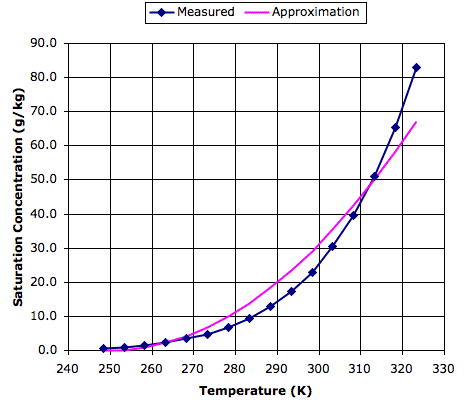
Looking at our graph of saturation concentration, we see that air with 50% humidity at 300 K contains around 25 g/kg of water. Suppose this air rises and a mere 1 g/kg of water vapor condenses. Our gas cells have mass 330 kg/m2, so when 1 g/kg of water condenses, there will be 330 g of water over each square meter of the cell's base area. This 330 g, if spread over a square meter, has depth 330 μm. According to our absorption spectrum for water, 330 μm of liquid water is more than enough to absorb all long-wave radiation, but not enough to absorb even 1% of sunlight.
The condensed water forms a cloud of water droplets. Cloud droplets are typically twenty micrometers in diameter. Our 330 g/m2 will form roughly a hundred billion such droplets. Sunlight passing vertically down through the cloud will encounter roughly thirty such droplets. Each drop will reflect and refract the light. We estimate that 10% of the descending sunlight will be reflected back out into space by such a cloud, while 90% will continue onwards. When 10 g/kg of water condenses, we will have 3.3 kg/m2 of water vapor, and sunlight will encounter 300 droplets instead of 30. The fraction of light passing through the cloud will be 0.910 = 35%, while 65% is reflected.
Thus we have a way of taking the concentration of condensed water in a gas cell, and calculating the fraction of light it will reflect back into space. We also have a simple way of handling the absorption and emission of long-wave radiation by clouds: any cloud in our simulation will be a both a perfect absorber and a perfect emitter of long-wave radiation.
We will soon implement cloud formation in our Circulating Cells program. We must decide how to implement their absorption and emission of long-wave radiation, and their reflection of sunlight.
Looking at our graph of saturation concentration, we see that air with 50% humidity at 300 K contains around 25 g/kg of water. Suppose this air rises and a mere 1 g/kg of water vapor condenses. Our gas cells have mass 330 kg/m2, so when 1 g/kg of water condenses, there will be 330 g of water over each square meter of the cell's base area. This 330 g, if spread over a square meter, has depth 330 μm. According to our absorption spectrum for water, 330 μm of liquid water is more than enough to absorb all long-wave radiation, but not enough to absorb even 1% of sunlight.
The condensed water forms a cloud of water droplets. Cloud droplets are typically twenty micrometers in diameter. Our 330 g/m2 will form roughly a hundred billion such droplets. Sunlight passing vertically down through the cloud will encounter roughly thirty such droplets. Each drop will reflect and refract the light. We estimate that 10% of the descending sunlight will be reflected back out into space by such a cloud, while 90% will continue onwards. When 10 g/kg of water condenses, we will have 3.3 kg/m2 of water vapor, and sunlight will encounter 300 droplets instead of 30. The fraction of light passing through the cloud will be 0.910 = 35%, while 65% is reflected.
Thus we have a way of taking the concentration of condensed water in a gas cell, and calculating the fraction of light it will reflect back into space. We also have a simple way of handling the absorption and emission of long-wave radiation by clouds: any cloud in our simulation will be a both a perfect absorber and a perfect emitter of long-wave radiation.
Saturday, September 3, 2011
Latent Heat
In Evaporation Rate we considered the rate at which water evaporates from the sea, and in Condensation Point we considered the amount of water that will condense from humid air when it cools down. Today we consider the heat absorbed by evaporating water, and the heat liberated by condensing water vapor.
It takes 2.2 MJ of heat to evaporate one kilogram of water. This heat is called the latent heat of evaporation. Two million Joules is enough energy to raise a 100 kg load to the top of a two thousand meter mountain. It is the energy released by the explosion of a stick of dynamite, or the energy we obtain from eating two jelly donuts.
For the purpose of our simulation, let us suppose that only the top one meter of water supplies the heat of evaporation. The heat capacity of water is 4.2 kJ/kg, so our surface blocks of water will have heat capacity of 4.2 MJ/m2. In an earlier example, we found that roughly 1.8 kg of water will evaporate every hour from each square meter of a lake at 290 K (14°C). The latent heat carried away by the evaporating water will come from the heat of the water it leaves behind, so the lake surface will cool by roughly 1°C/hr.
As we saw in Back Radiation, the lake absorbs heat from the sun during the day, and always radiates heat upwards. In Surface Cooling, Part I, we showed how a water surface heats up by less than 1°C during the day. A lake does not get hot enough with respect to the air above to cause significant convection. Thus heat loss by a water surface is dominated by radiation and evaporation.
When water vapor condenses from cooling, humid air, it releases its latent heat into the air around it. The volume occupied by the water vapor decreases by a factor of a thousand then it condenses, but at the same time its latent heat warms up the air, causing the air to expand. In Condensation and Convection we found that the expansion due to warming dominates the contraction due to condensation by almost an order of magnitude. A single gram of water vapor condensing out of kilogram of air causes the air volume to increase by 1%. When air expands, it becomes buoyant, so it will have latent heat of fusion. This is the heat required to melt ice, which is liberated when the water freezes. Water's latent heat of fusion is roughly 330 kJ/kg. If we have one gram of water freezing in 1 kg of air, the air will warm by roughly 0.3°C.
We can now implement in our Circulating Cells program the evaporation of water from the planet surface, its subsequent condensation into clouds of droplets in rising gas cells, and its eventual freezing into ice crystals. These clouds will, however, have a strong effect upon the manner in which the atmosphere radiates heat into space.
In Thick Clouds we saw how low, thick clouds block the sun's light from reaching the ground, thus causing it to cool down. In High Clouds we saw how thin, high clouds allow the sun's light to pass through, but block radiation by the planet surface, thus causing the surface to warm up.
Before we can implement clouds properly in our simulation, we must consider how to model their effect upon sunlight and radiation.
It takes 2.2 MJ of heat to evaporate one kilogram of water. This heat is called the latent heat of evaporation. Two million Joules is enough energy to raise a 100 kg load to the top of a two thousand meter mountain. It is the energy released by the explosion of a stick of dynamite, or the energy we obtain from eating two jelly donuts.
For the purpose of our simulation, let us suppose that only the top one meter of water supplies the heat of evaporation. The heat capacity of water is 4.2 kJ/kg, so our surface blocks of water will have heat capacity of 4.2 MJ/m2. In an earlier example, we found that roughly 1.8 kg of water will evaporate every hour from each square meter of a lake at 290 K (14°C). The latent heat carried away by the evaporating water will come from the heat of the water it leaves behind, so the lake surface will cool by roughly 1°C/hr.
As we saw in Back Radiation, the lake absorbs heat from the sun during the day, and always radiates heat upwards. In Surface Cooling, Part I, we showed how a water surface heats up by less than 1°C during the day. A lake does not get hot enough with respect to the air above to cause significant convection. Thus heat loss by a water surface is dominated by radiation and evaporation.
When water vapor condenses from cooling, humid air, it releases its latent heat into the air around it. The volume occupied by the water vapor decreases by a factor of a thousand then it condenses, but at the same time its latent heat warms up the air, causing the air to expand. In Condensation and Convection we found that the expansion due to warming dominates the contraction due to condensation by almost an order of magnitude. A single gram of water vapor condensing out of kilogram of air causes the air volume to increase by 1%. When air expands, it becomes buoyant, so it will have latent heat of fusion. This is the heat required to melt ice, which is liberated when the water freezes. Water's latent heat of fusion is roughly 330 kJ/kg. If we have one gram of water freezing in 1 kg of air, the air will warm by roughly 0.3°C.
We can now implement in our Circulating Cells program the evaporation of water from the planet surface, its subsequent condensation into clouds of droplets in rising gas cells, and its eventual freezing into ice crystals. These clouds will, however, have a strong effect upon the manner in which the atmosphere radiates heat into space.
In Thick Clouds we saw how low, thick clouds block the sun's light from reaching the ground, thus causing it to cool down. In High Clouds we saw how thin, high clouds allow the sun's light to pass through, but block radiation by the planet surface, thus causing the surface to warm up.
Before we can implement clouds properly in our simulation, we must consider how to model their effect upon sunlight and radiation.
Subscribe to:
Posts (Atom)