The anthropogenic global warming (AGW) hypothesis presented by the majority of today's climatologists has two parts. First it claims that the world is getting exceptionally warm, and second it claims that human carbon dioxide (CO2) emissions are the cause of this warming. Seven years ago, we began our personal investigation of this hypothesis, and we did so by considering whether or not the world was indeed getting exceptionally warm.
The first thing we did was estimate the uncertainty inherent in the measurements of global surface temperature. We concluded that natural variations in local climate introduce an error of roughly 0.14°C in the measurement of the change in temperature between any two points in time. The fact that the error is constant with the time over which we measure the change is a consequence of the particular characteristics of local climate fluctuations.
We downloaded the weather station data from NCDC and calculated the global surface anomaly using a method we called integrated derivatives, but which others have called first differences. The graph we obtained was almost identical to the one obtained by CRU using their complex reference grid method. It remains a mystery to us why institutions like CRU, NASA, and NCDC use such a complex method when a far simpler one will do. All graphs show roughly a 0.6°C rise in global surface temperature from 1950 to 2000. This rise is significant compared to our expected resolution of 0.14°C.
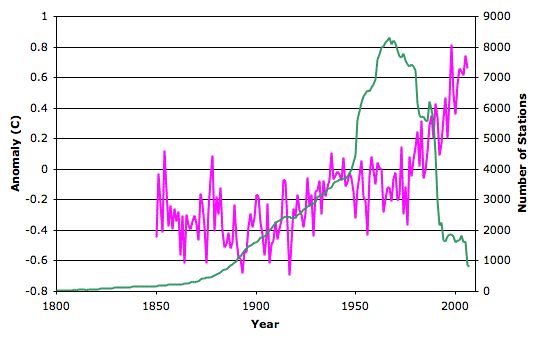
We made this plot superimposing the number of weather stations and the global surface anomaly versus time. The number of weather stations drops dramatically from 1960 and 1990. Only one in four remain active at the end of this thirty-year period. During the same period, the global surface anomaly shows a 0.6°C rise. By selecting subsets of the weather stations, we found that the apparent warming from 1950 to 1990 varied from 0.3°C to 1.0°C depending upon whether we used stations that disappeared in that period, persisted through that period, or existed shorter or longer intervals in the same century. Thus is seemed to us that some significant amount of work would have to be done to eliminate the change in the number of weather stations as a source of error in the data. But we saw no mention whatsoever of this source of error in published papers in which the global surface anomaly is presented, such as Jones et al..
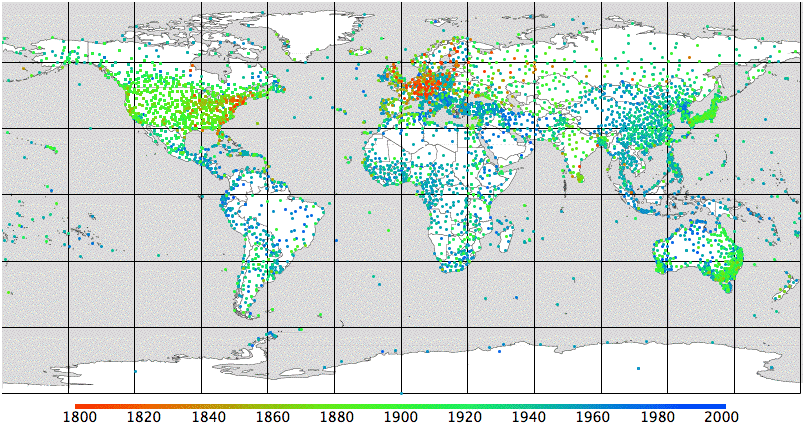
We plotted a global map of the available weather stations, color-coded to show the date they first started reporting. The map shows that almost all stations in the tropics began operating after 1930, while most of those in the temperate regions were operating by 1880. This seems to us to be another source of systematic error in our measurement of the global surface anomaly.
Weather stations might also be affected by the appearance of buildings, tarmac, and road traffic. We found examples of weather stations in which such urban heating caused an apparent warming of several degrees centigrade over a few decades. It seemed to us that this effect would have to be examined in depth by any paper presenting a global surface trend. But papers such as Jones et al. do not address the urban heating issue directly. Instead, they claim that the effect is negligible and refer to other papers as proof. But when we looked up those other papers, we did not find any such proof.
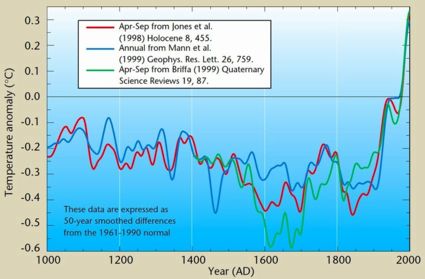
In order to argue that modern temperatures were exceptionally warm, climatologists produced the hockey stick graph, in which a collection of potential long-term measurements of global surface temperature were combined together under the assumption that they could be trusted only to the extent that they showed a temperatures increase from 1950 to 2000. Indeed, if a measurement showed a temperature decline in that period, the hockey stick method would flip the trend over and add it to the combination so that it now contributed to a rise in the same period.
The hockey-stick graph shows no sign of the Medieval Warm Period, in which Greenland was inhabited by farmers, nor the Little Ice Age, when the Thames was known to freeze over, and nor should we expect it to. Given a random set of measurements, the hockey-stick combination method will almost always produce a graph that shows a sharp rise from 1950 to 2000 and a gentle descent during the thousand years before-hand. When applied to the existing measurements of temperature by tree rings, ice cores, and other such indirect methods, it is no surprise that the method produced that same shape.
We presented our doubts about the surface temperature measurements and the hockey stick graph to believers in the AGW hypothesis. We were received with disdain and given no satisfactory answers. Furthermore, the Climategate affair revealed several significant breaches of scientific method by the climate science community. For example, in this graph produced by climatologists for the World Health Organization, the authors removed the tree ring temperature data from 1960 onwards because it showed a decline in temperature, and substituted temperature station measurements in their place. They plotted the combination as a single line. When I asked a prominent climatologists what exactly had been done, he said, "The smooth was calculated using instrumental data past 1960." He declared that a better way to handle the divergence of the tree-ring data from the station measurements would be to cut short the graph of tree-ring data at 1960, so as to hide the decline in temperatures measured by the tree rings.
What we see here is the assumption by climatologists that the world has been warming up and that the global temperature measured by weather stations is correct. This assumption leads them to delete conflicting data on the grounds that it must be bad data. Thus it becomes impossible for them to discover that their assumption is incorrect. By this time, we were skeptical of the global surface anomaly we obtained from the station data. We were no longer certain that the data itself had not been modified by NCDC. We had little reason to trust any other measurement produced by climatologists, we were unimpressed with the hockey-stick method of combining measurements, and we were quite certain that recent temperatures were not exceptional for the past ten thousand years.
We turned our attention to the second part of the AGW hypothesis: the one that says doubling the atmosphere's CO2 concentration will increase the surface temperature by roughly 3°C. It took us a long time to come to a conclusion on this one. The climate models upon which such predictions are based are private property of various climatologists. In any event, we do not trust models produced by a community that is willing to delete data that conflict with its assumptions. If they are willing to delete data, we must assume that they are willing to adjust their models until the models give predictions consistent with their AGW hypothesis.
We began with some laboratory experiments on radiation. We stated the principle of the greenhouse effect. After a great deal of searching around, we eventually obtained the absorption spectrum of various layers of the Earth's atmosphere. This allowed us to confirm that, if the skies remained clear, a doubling of CO2 concentration would cause the world to warm up by about 1.5°C.
But of course the skies don't remain clear. The formation of clouds is a strong function of surface temperature. If the world warms up, there will be more clouds. They will reflect more of the Sun's light, while at the same time, slowing down the radiation of heat into space by the Earth. To determine how these two effects would interact, we built our own climate model, which we called Circulating Cells.
When it comes to determining the effect of increased cloud cover, the most critical parameter to decide upon is the reflection of sunlight by clouds per millimeter of water depth in the cloud. It seemed to us that there should be a large body of literature written recently upon this subject because it is so important to climate modeling. The best paper we found upon the subject was written in 1948, Reflection, Absorption, and Transmission of Insolation by Stratus Cloud. We found a couple of more recent papers about reflection, such as this one, but they do not attempt to provide an empirical formula for the reflection of clouds with increasing cloud depth. We concluded that climatologists are not examining this issue in detail.
In a long sequence of small steps, we built up our climate model until it implemented surface convection, surface heat capacity, evaporation, cloud formation, precipitation, and radiation by clouds. We tested every aspect of the simulation in detail, and based its operating parameters upon our own estimates and upon whatever measurements we could find in climate science journals. We did not choose our model parameters to suit any hypothesis of our own, nor could we have done, because we did not have a model capable of testing the AGW hypothesis until the final stage, and we did not change the parameters in that final stage.
The latest version of our climate model shows that cloud cover increases rapidly as the surface warms above the freezing point of water. The evaporation rate of water from the surface increases approximately as the square of the temperature above freezing, and the only way for water to return to the surface is to form a cloud first. If we ignore the increased reflection of sunlight due to increasing cloud cover, and consider only the slowing-down of radiation into space by the same increase in cloud cover, our model shows roughly 3°C of warming due to a doubling in CO2 concentration. But when we take account of the increased reflection of sunlight by the increasing cloud cover, the warming drops to 0.9°C.
It seems to us that the climate models used by climatologists ignore the reflection of sunlight due to clouds. They may allow for some fixed fraction of sunlight to be reflected by clouds, but they do not allow this fraction to increase with increasing surface temperature. Thus they conclude that the warming due to CO2 doubling will be 3°C. If they took account of the increased reflection, the effect would be far smaller and less dramatic: roughly 1°C.
Doubling the CO2 concentration of the atmosphere will indeed encourage the world to warm up, but not by enough that we should worry. Right now CO2 concentration has increased from roughly 300 ppm to 400 ppm in the past century. If it gets to 600 ppm then we can say that the rise in CO2 concentration will tend to warm the Earth by 1°C. But we are unlikely to be able to check our calculations, because the natural variation in the Earth's climate is itself of order ±1°C from one century to the next.
And so we find ourselves at the end of our journey. Modern warming is not exceptional, and doubling the CO2 concentration will cause the world to warm up by roughly 1°C, not 3°C. The only part of the AGW theory we have not investigated is its assertion that human CO2 emissions are responsible for the increase in atmospheric CO2 concentration over the past century.
My thanks to those of you who took part in the effort, both by private e-mails and in the comments. I would not have continued the effort without your participation. I hope it is clear that my use of "we" instead of "I" is in recognition of the fact that this has been a group effort. I will continue to answer comments on this site, and I will consider any suggestions of further work. To the first approximation, however: we're done.
Showing posts with label Climategate. Show all posts
Showing posts with label Climategate. Show all posts
Wednesday, April 4, 2012


Sunday, August 8, 2010
This Time It's Different
In The Right and the Climate, an opinion piece for the New York Times, Ross Douthat discusses the abandonment of cap-and-trade legislation by the US senate. He argues that Democrats must share the blame for the failure of cap-and-trade because they have exhausted the population's patience for doomsday stories. "The Seventies were a great decade for apocalyptic enthusiasms, and none was more potent than the fear that human population growth had outstripped the earth’s carrying capacity," he says. "The catastrophes never materialized, and global living standards soared." But the global warming doomsday story is different, Douthat says, because, "History, however, rarely repeats itself exactly — and conservatives who treat global warming as just another scare story are almost certainly mistaken."
People like Paul Ehrlich, who predicted global famine, and Rachel Carson, who claimed that DDT was killing humans, both believed in what they were saying. It turns out that they were wrong in their most famous claims, but they were doing their best to understand the dangers presented by lower infant mortality and widespread use of new chemicals. They believed in their cause and they believed in what they told us.
When Douthat says, "the evidence that carbon emissions are altering the planet’s ecology is too convincing to ignore," he seems to think that the evidence for global famine and chemical poisoning were unconvincing at the time that Ehrlich and Carson made their claims. But that's not the case. The evidence was convincing. A lot of people were convinced, including the US government under John Kennedy. But "convincing" is not the same as "correct". It turns out that their arguments were convincing but not correct.
Douthat is an example of the many well-educated people who have chosen to believe in anthropogenic global warming despite the history of environmental scare-mongering. The internet bubble was caused by people saying "this time it's different: revenue counts, not profit." The housing bubble was caused by people saying, "this time it's different: prices will never go down." The anthropomorphic global warming bubble has been caused by people saying, "this time it's different: the evidence is too compelling."
Here's my prediction: this time it's not different.
People like Paul Ehrlich, who predicted global famine, and Rachel Carson, who claimed that DDT was killing humans, both believed in what they were saying. It turns out that they were wrong in their most famous claims, but they were doing their best to understand the dangers presented by lower infant mortality and widespread use of new chemicals. They believed in their cause and they believed in what they told us.
When Douthat says, "the evidence that carbon emissions are altering the planet’s ecology is too convincing to ignore," he seems to think that the evidence for global famine and chemical poisoning were unconvincing at the time that Ehrlich and Carson made their claims. But that's not the case. The evidence was convincing. A lot of people were convinced, including the US government under John Kennedy. But "convincing" is not the same as "correct". It turns out that their arguments were convincing but not correct.
Douthat is an example of the many well-educated people who have chosen to believe in anthropogenic global warming despite the history of environmental scare-mongering. The internet bubble was caused by people saying "this time it's different: revenue counts, not profit." The housing bubble was caused by people saying, "this time it's different: prices will never go down." The anthropomorphic global warming bubble has been caused by people saying, "this time it's different: the evidence is too compelling."
Here's my prediction: this time it's not different.
Monday, April 26, 2010
Committees and Law Suits
Michael Mann, of Mann-Made Warming, has hired a law firm. His law firm wrote to Minnesotans for Global Warming (MGW), the makers of the Hide the Decline music video. This video uses a photograph of Dr. Mann's face. The letter from the lawyers demands that MGW stop using Dr. Mann's likeness, saying the "video clearly defames Professor Mann by leaving viewers with the incorrect impression that he falsified data to generate desired results". Youtube has removed all copies of the video, as well as a new version that does not use Dr. Mann's face. But No Cap and Trade is still hosting the original video, which I linked to earlier in this paragraph.
If Dr. Mann goes to court with MGW, his lawyers will argue that he did not fabricate measurements or data. But the defense will be able to address the definition of "data" and "measurement", and so shine light upon the idea of "value-added data" and "multi-proxy statistics". Dr. Mann combined measurements in a way that created a hockey-stick graph regardless of the input data, and even goes so far as to invert measurements that decline, so they rise instead, and contribute to the hockey-stick shape. Dr. Mann presented his Hockey Stick Graph as if it were a measurement. Either he knew full well that he was falsifying this measurement, or he became confused and did not understand his own mistake. Subsequent inquiries prompted by the work of Mr. McIntyre gave Dr. Mann ample opportunity to see his error and withdraw his graph. But Dr. Mann still insists that his graph is a useful measurement of global temperature changes over the past thousand years.
A law suit bestows the power of subpoena. Dr. Mann could be interrogated in court or during depositions. He would have to answer questions about his work. He would not be able to dismiss the inverted-measurement accusation as "bizarre" and say nothing more about it. So I hope the case goes to court. I would donate to the MGW legal fund.
Here's another law suit. Climate modeler Andrew Weaver asked Canada's National Post to "retract a number of recent articles that attributed to me statements I never made, accused me of things I never did, and attacked me for views I never held." Perhaps Mr. Weaver is referring to articles like this, in which he comes across as a conspiracy theorist. The National Post refused to retract their statements, so Mr. Weaver is suing them for "grossly irresponsible falsehoods" and for insults posted in the on-line comments.
Mr. Weaver's case looks like it will degenerate into an argument about what he said in interviews, not an argument about the science. So I'm not as enthusiastic about his law suit. I hope the paper did not misrepresent him. I image being misrepresented must be frustrating.
A second inquiry into Climategate has produced its conclusion. This inquiry was headed by Lord Oxburgh and was instigated by the University of East Anglia, home of the Climatic Research Unit (CRU) and epicenter of the entire affair. The inquiry concluded that the scientists involved did nothing wrong. This conclusion has been greeted with enthusiasm by most climatologists, such as those providing content at Realclimate, but there are some climatologists who are not satisfied by either the Oxburgh Report or the Parliamentary Report. Vocal among the critics of these reports is Judith Curry. She notes, and we agree with her, that neither report addresses any of the main issues raised by critics of climate science, such as those listed in by Mr. McIntyre in his submission to the Parliamentary Committee. But the two inquiries were supposed to identify any "wrong-doing" on the part of CRU scientists. I'm not sure what "wrong-doing" is.
The point of Climategate is that climatologists don't obey the same rules as the rest of us in other fields of science. We don't substitute instrument data for proxy data and then plot the result as if it were all proxy data (Gavin Schmidt). If I were to hide a trend using a trick, I would deserve to be fired from my position. It's not up to committees to condemn climatologists. It's up to us scientists in other fields to distance ourselves from their work so that their field can no longer lay claim to the authority that has been earned by properly-conducted science over the past three centuries.
These law suits hold more promise than the committees. In the law suits, the definition of scientific conduct would be addressed, and judges are good at understanding the logic of definitions. Let's not forget the great work done by Judge John E. Jones on the subject of intelligent design. He judged that the definition of "science" was that it addressed natural phenomena only, so any theory, such as intelligent design, which mentioned the existence of a super-natural being, was by definition non-scientific, regardless of its truth or falsehood. We need a judge like him in the Dr. Mann vs. MGW case.
If Dr. Mann goes to court with MGW, his lawyers will argue that he did not fabricate measurements or data. But the defense will be able to address the definition of "data" and "measurement", and so shine light upon the idea of "value-added data" and "multi-proxy statistics". Dr. Mann combined measurements in a way that created a hockey-stick graph regardless of the input data, and even goes so far as to invert measurements that decline, so they rise instead, and contribute to the hockey-stick shape. Dr. Mann presented his Hockey Stick Graph as if it were a measurement. Either he knew full well that he was falsifying this measurement, or he became confused and did not understand his own mistake. Subsequent inquiries prompted by the work of Mr. McIntyre gave Dr. Mann ample opportunity to see his error and withdraw his graph. But Dr. Mann still insists that his graph is a useful measurement of global temperature changes over the past thousand years.
A law suit bestows the power of subpoena. Dr. Mann could be interrogated in court or during depositions. He would have to answer questions about his work. He would not be able to dismiss the inverted-measurement accusation as "bizarre" and say nothing more about it. So I hope the case goes to court. I would donate to the MGW legal fund.
Here's another law suit. Climate modeler Andrew Weaver asked Canada's National Post to "retract a number of recent articles that attributed to me statements I never made, accused me of things I never did, and attacked me for views I never held." Perhaps Mr. Weaver is referring to articles like this, in which he comes across as a conspiracy theorist. The National Post refused to retract their statements, so Mr. Weaver is suing them for "grossly irresponsible falsehoods" and for insults posted in the on-line comments.
Mr. Weaver's case looks like it will degenerate into an argument about what he said in interviews, not an argument about the science. So I'm not as enthusiastic about his law suit. I hope the paper did not misrepresent him. I image being misrepresented must be frustrating.
A second inquiry into Climategate has produced its conclusion. This inquiry was headed by Lord Oxburgh and was instigated by the University of East Anglia, home of the Climatic Research Unit (CRU) and epicenter of the entire affair. The inquiry concluded that the scientists involved did nothing wrong. This conclusion has been greeted with enthusiasm by most climatologists, such as those providing content at Realclimate, but there are some climatologists who are not satisfied by either the Oxburgh Report or the Parliamentary Report. Vocal among the critics of these reports is Judith Curry. She notes, and we agree with her, that neither report addresses any of the main issues raised by critics of climate science, such as those listed in by Mr. McIntyre in his submission to the Parliamentary Committee. But the two inquiries were supposed to identify any "wrong-doing" on the part of CRU scientists. I'm not sure what "wrong-doing" is.
The point of Climategate is that climatologists don't obey the same rules as the rest of us in other fields of science. We don't substitute instrument data for proxy data and then plot the result as if it were all proxy data (Gavin Schmidt). If I were to hide a trend using a trick, I would deserve to be fired from my position. It's not up to committees to condemn climatologists. It's up to us scientists in other fields to distance ourselves from their work so that their field can no longer lay claim to the authority that has been earned by properly-conducted science over the past three centuries.
These law suits hold more promise than the committees. In the law suits, the definition of scientific conduct would be addressed, and judges are good at understanding the logic of definitions. Let's not forget the great work done by Judge John E. Jones on the subject of intelligent design. He judged that the definition of "science" was that it addressed natural phenomena only, so any theory, such as intelligent design, which mentioned the existence of a super-natural being, was by definition non-scientific, regardless of its truth or falsehood. We need a judge like him in the Dr. Mann vs. MGW case.
Monday, April 12, 2010
Ecocide
This Sunday's Guardian tells us of an effort by This is Ecocide to get the UN to recognize a fifth form of crime against humanity. They call the new crime "ecocide". On their solution page, Ecocide tells us that "ecocide can be the outcome of external factors, such as flooding or an earthquake".
If an earthquake occurs, I'm guessing the Earth's tectonic plates are to blame. It's not clear how any criminal group could cause an earthquake and then be prosecuted for it. Maybe if they did it with a thermonuclear weapon, but we already have laws against letting off thermonuclear weapons. If a flood occurs, I'm guessing it's the weather that's to blame. It's not clear how any criminal group could be prosecuted for that.
But they must have had someone in mind when they said a flood could be ecocide. What did they have in mind? What if a group of people prevent, by deliberate misinformation, the passage of laws that would otherwise have prevented the flood? What if a group of climate skeptics prevented the passage of a law that would reduce carbon dioxide emissions? Would they be guilty of ecocide?
I don't think the ecocide law would work well with the US constitution.
UPDATE: Is the volcanic eruption in iceland an act of ecocide, and if so, who is responsible?
If an earthquake occurs, I'm guessing the Earth's tectonic plates are to blame. It's not clear how any criminal group could cause an earthquake and then be prosecuted for it. Maybe if they did it with a thermonuclear weapon, but we already have laws against letting off thermonuclear weapons. If a flood occurs, I'm guessing it's the weather that's to blame. It's not clear how any criminal group could be prosecuted for that.
But they must have had someone in mind when they said a flood could be ecocide. What did they have in mind? What if a group of people prevent, by deliberate misinformation, the passage of laws that would otherwise have prevented the flood? What if a group of climate skeptics prevented the passage of a law that would reduce carbon dioxide emissions? Would they be guilty of ecocide?
I don't think the ecocide law would work well with the US constitution.
UPDATE: Is the volcanic eruption in iceland an act of ecocide, and if so, who is responsible?
Wednesday, March 31, 2010
Parliamentary Report
The UK parliament announced the results of its enquiry into Climategate today. Here's an excerpt.
On the much cited phrases in the leaked e-mails—"trick" and "hiding the decline"—the Committee considers that they were colloquial terms used in private e-mails and the balance of evidence is that they were not part of a systematic attempt to mislead.
Our readers are familiar with the this graph, in which the green line has been faked from 1960 onwards by deleting the tree-ring data, which went down sharply after 1960, and replacing it with thermometer data, which went up sharply after 1960. This was one version of the "trick" to "hide the decline". Another version is shown in these graphs, where the tree-ring data is simply cut short at 1960, leaving only upward graphs from that time onwards. All participants in these efforts to "hide the decline" are unashamed and open about the "trick". They say they omitted or replaced the tree-ring data because they knew it was unreliable.
I believe they are sincere. So I guess I agree with the parliament's conclusion: the scientists involved were not deliberately deceiving anyone. They believed that their graphs were consistent with the Ultimate Truth, which is that the world is getting warmer fast, and human beings are responsible for the warming. Any data that showed otherwise must, by assumption, be wrong, so it should not be plotted.
A scientist that puts his theory before the data will never discover anything new. He will never discover that he is wrong. None of us have any interest in giving him money to make discoveries because we know perfectly well he's not going to make any. The only reason to give him money is so he can keep repeating his theory to us over and over again. Putting the data first is hard. It requires mental discipline, and it is this discipline that gives science its high social standing.
Let us suppose, for the sake of argument, that a climatologist was deliberately deceiving the public about the science of global warming. This would imply that the climatologist had put the data first and reached a conclusion consistent with the data. After that, he went about telling people something opposite to the conclusion he came to. Thus we have a self-disciplined scientist who chooses to lie to people. I don't think that's possible. A self-disciplined scientist can get a job anywhere, be paid well, and sleep easily at night knowing that he has his honor intact. Why would such a person deceive anyone?
The climatologists who took part in hiding the decline are not self-disciplined in the sense I described above. They don't even know what we are talking about when we say they should put the data first. They think they are putting the data first. They don't realize what they have done wrong, other than that it got them into trouble.
All this to say: climatologists were not lying, but they have lost their reputation among other scientists, and there's no undoing that fact. As a scientist, all you have is your reputation. Once you lose it, you never get it back.
On the much cited phrases in the leaked e-mails—"trick" and "hiding the decline"—the Committee considers that they were colloquial terms used in private e-mails and the balance of evidence is that they were not part of a systematic attempt to mislead.
Our readers are familiar with the this graph, in which the green line has been faked from 1960 onwards by deleting the tree-ring data, which went down sharply after 1960, and replacing it with thermometer data, which went up sharply after 1960. This was one version of the "trick" to "hide the decline". Another version is shown in these graphs, where the tree-ring data is simply cut short at 1960, leaving only upward graphs from that time onwards. All participants in these efforts to "hide the decline" are unashamed and open about the "trick". They say they omitted or replaced the tree-ring data because they knew it was unreliable.
I believe they are sincere. So I guess I agree with the parliament's conclusion: the scientists involved were not deliberately deceiving anyone. They believed that their graphs were consistent with the Ultimate Truth, which is that the world is getting warmer fast, and human beings are responsible for the warming. Any data that showed otherwise must, by assumption, be wrong, so it should not be plotted.
A scientist that puts his theory before the data will never discover anything new. He will never discover that he is wrong. None of us have any interest in giving him money to make discoveries because we know perfectly well he's not going to make any. The only reason to give him money is so he can keep repeating his theory to us over and over again. Putting the data first is hard. It requires mental discipline, and it is this discipline that gives science its high social standing.
Let us suppose, for the sake of argument, that a climatologist was deliberately deceiving the public about the science of global warming. This would imply that the climatologist had put the data first and reached a conclusion consistent with the data. After that, he went about telling people something opposite to the conclusion he came to. Thus we have a self-disciplined scientist who chooses to lie to people. I don't think that's possible. A self-disciplined scientist can get a job anywhere, be paid well, and sleep easily at night knowing that he has his honor intact. Why would such a person deceive anyone?
The climatologists who took part in hiding the decline are not self-disciplined in the sense I described above. They don't even know what we are talking about when we say they should put the data first. They think they are putting the data first. They don't realize what they have done wrong, other than that it got them into trouble.
All this to say: climatologists were not lying, but they have lost their reputation among other scientists, and there's no undoing that fact. As a scientist, all you have is your reputation. Once you lose it, you never get it back.
Thursday, March 4, 2010
Truth by Law
Peter Newnam points us to Memorandum submitted by Dr Sonja Boehmer-Christiansen (CRU 26).
"This cause of environmental protection had from the start natural allies in the EU Commission, United Nation and World Bank. CRU, working for the UK government and hence the IPCC, was expected to support the hypothesis of man-made, dangerous warming caused by carbon dioxide, a hypothesis it had helped to formulate in the late 1980s and which became "true" in international law with the adoption of the 1992 Framework Convention on Climate Change."
That's an interesting concept: the truth of anthropogenic global warming was enshrined in international law. In the United States, the EPA has decided that carbon dioxide is dangerous to human health. Once these statements about the natural world become enshrined in the law, any opposition to the statements becomes opposition to the law. Opposition to a law is not, in itself, a crime. But the opposer now finds himself being compared to someone who is making excuses for not obeying the law. Oil companies were placed in that position by the international laws, and automobile companies are in that position with respect to our EPA.
I'm not complaining: the truth is coming out in the end.
"This cause of environmental protection had from the start natural allies in the EU Commission, United Nation and World Bank. CRU, working for the UK government and hence the IPCC, was expected to support the hypothesis of man-made, dangerous warming caused by carbon dioxide, a hypothesis it had helped to formulate in the late 1980s and which became "true" in international law with the adoption of the 1992 Framework Convention on Climate Change."
That's an interesting concept: the truth of anthropogenic global warming was enshrined in international law. In the United States, the EPA has decided that carbon dioxide is dangerous to human health. Once these statements about the natural world become enshrined in the law, any opposition to the statements becomes opposition to the law. Opposition to a law is not, in itself, a crime. But the opposer now finds himself being compared to someone who is making excuses for not obeying the law. Oil companies were placed in that position by the international laws, and automobile companies are in that position with respect to our EPA.
I'm not complaining: the truth is coming out in the end.
Sunday, February 28, 2010
Climategate and Parliament
On 22nd January 2010, the UK parliament's science and technology committee announced an inquiry into Climategate. Steve McIntyre of Climate Audit made this submission to the committee.
In his submission, Mr. McIntyre compares graphs of data that various climatologists attempted to keep private to the graphs of data that these same climatologists published in their papers. The private data shows a prominent medieval warm period. The published data shows no medieval warm period. The published data suggests that the twentieth century warming is unprecedented. The private data shows quite the opposite. Mr. McIntyre also presents the substitution of thermometer measurements for tree-ring proxy measurements by CRU in 1999, and the deletion of post-1960 tree-ring proxy measurements from the published data sets.
I spent ten minutes looking for a similar submission from the authors of Real Climate, but found none. I did, however, note that recent posts on Real Climate are dominated by assertions that the mainstream media, in particular UK newspapers, are doing a bad job reporting on Climategate. In The Guardian Disappoints, Gavin Schmidt talks of a "complete collapse" in reporting standards in the UK. What I can't find anywhere is the sort of succinct refutation that will be necessary to rebut Mr. MacIntyre's submission to parliament.
On the one hand, we have skeptics who believe in the open disclosure of all data, even when the data conflicts with a scientist's beliefs. On the other hand, we have climatologists who believe the best way to present science to the public is to shield them from data that they would otherwise misunderstand, or which would give fuel to the unreasonable arguments of climate skeptics. It may be that climatologists are absolutely right about anthropogenic global warming and its up-coming catastrophic effects. It may be that they are doing the right and moral thing by hiding the decline. But most of us don't like to have other people hiding things from us. We don't like anyone suggesting that a lunatic can get hold of the wrong data and make us believe something absurd. The climatologist's approach to the public may be caring, but it is also disdainful.
Climatologists have so much invested in their theory of anthropogenic global warming that it's unreasonable to expect them to back down and change their way of doing business after Climategate. We, the public who pay their salaries, will eventually insist that they do the job we want them to do in the way we want them to do it. But until that then, climatologists will stick to their existing methods and remain unrepentant.
After all, there are still people out there who believe that crop circles are made by aliens.
UPDATE: Thanks to Chuck for pointing to the submission of the Institute for Physics.
UPDATE: People who study crop circles are called cereologists.
In his submission, Mr. McIntyre compares graphs of data that various climatologists attempted to keep private to the graphs of data that these same climatologists published in their papers. The private data shows a prominent medieval warm period. The published data shows no medieval warm period. The published data suggests that the twentieth century warming is unprecedented. The private data shows quite the opposite. Mr. McIntyre also presents the substitution of thermometer measurements for tree-ring proxy measurements by CRU in 1999, and the deletion of post-1960 tree-ring proxy measurements from the published data sets.
I spent ten minutes looking for a similar submission from the authors of Real Climate, but found none. I did, however, note that recent posts on Real Climate are dominated by assertions that the mainstream media, in particular UK newspapers, are doing a bad job reporting on Climategate. In The Guardian Disappoints, Gavin Schmidt talks of a "complete collapse" in reporting standards in the UK. What I can't find anywhere is the sort of succinct refutation that will be necessary to rebut Mr. MacIntyre's submission to parliament.
On the one hand, we have skeptics who believe in the open disclosure of all data, even when the data conflicts with a scientist's beliefs. On the other hand, we have climatologists who believe the best way to present science to the public is to shield them from data that they would otherwise misunderstand, or which would give fuel to the unreasonable arguments of climate skeptics. It may be that climatologists are absolutely right about anthropogenic global warming and its up-coming catastrophic effects. It may be that they are doing the right and moral thing by hiding the decline. But most of us don't like to have other people hiding things from us. We don't like anyone suggesting that a lunatic can get hold of the wrong data and make us believe something absurd. The climatologist's approach to the public may be caring, but it is also disdainful.
Climatologists have so much invested in their theory of anthropogenic global warming that it's unreasonable to expect them to back down and change their way of doing business after Climategate. We, the public who pay their salaries, will eventually insist that they do the job we want them to do in the way we want them to do it. But until that then, climatologists will stick to their existing methods and remain unrepentant.
After all, there are still people out there who believe that crop circles are made by aliens.
UPDATE: Thanks to Chuck for pointing to the submission of the Institute for Physics.
UPDATE: People who study crop circles are called cereologists.
Sunday, February 14, 2010
Medieval Warm Period
Dr. Phil Jones, former director of CRU (Climatic Research Unit) at UAE (University of East Anglia), granted an interview of sorts to the BBC. They sent him questions, and he answered them, including links to graphs. You will find the complete exchange here. Dr. Jones is at the center of the Climategate affair. His answers to the BBC seem sincere and thorough to me. The last few months must have been hard on Dr. Jones. I'm glad to see him talking to the press. The BBC's questions were pointed. There is no sign of the global warming zealotry that I had come to expect from the BBC. I'm sure Climategate has been hard on the global warming zealots as well. But the BBC appears to be responding by putting their journalistic principles first.
Of particular importance to the debate over the Hockey Stick graph and its associated Mann-Made Warming, is the existence or non-existence of the Medieval Warm Period (MWP). The BBC asked Dr. Jones if the MWP was warmer than today, and here's his answer.
"There is much debate over whether the Medieval Warm Period was global in extent or not. The MWP is most clearly expressed in parts of North America, the North Atlantic and Europe and parts of Asia. For it to be global in extent the MWP would need to be seen clearly in more records from the tropical regions and the Southern Hemisphere. There are very few palaeoclimatic records for these latter two regions."
Indeed: there is plenty of evidence in the Northern Hemisphere that the MWP was 2°C warmer than today. Even the IPPC said as much back in 1995, before the Hockey Stick graph was published. Whether or not we need evidence from the Southern Hemisphere to believe in the MWP is a matter of opinion. If it were possible for the Northern Hemisphere to warm 2°C while leaving the Southern Hemisphere unchanged, this would suggest that a 2°C warming can be both natural and local. If the MWP were global, we see that a 2°C warming can be natural. Either way, the Northern Hemisphere's MWP is evidence that 2°C warming from current temperatures can occur naturally.
Dr. Jones's full answer shows that he understands the implications of the MWP. In another answer, he says there has been no statistically significant warming since 1995, but he adds that, "This trend (0.12C per decade) is positive, but not significant at the 95% significance level. The positive trend is quite close to the significance level." Reports of Dr. Jones performing a U-Turn appear to be over-blown. But at least he is talking.
Of particular importance to the debate over the Hockey Stick graph and its associated Mann-Made Warming, is the existence or non-existence of the Medieval Warm Period (MWP). The BBC asked Dr. Jones if the MWP was warmer than today, and here's his answer.
"There is much debate over whether the Medieval Warm Period was global in extent or not. The MWP is most clearly expressed in parts of North America, the North Atlantic and Europe and parts of Asia. For it to be global in extent the MWP would need to be seen clearly in more records from the tropical regions and the Southern Hemisphere. There are very few palaeoclimatic records for these latter two regions."
Indeed: there is plenty of evidence in the Northern Hemisphere that the MWP was 2°C warmer than today. Even the IPPC said as much back in 1995, before the Hockey Stick graph was published. Whether or not we need evidence from the Southern Hemisphere to believe in the MWP is a matter of opinion. If it were possible for the Northern Hemisphere to warm 2°C while leaving the Southern Hemisphere unchanged, this would suggest that a 2°C warming can be both natural and local. If the MWP were global, we see that a 2°C warming can be natural. Either way, the Northern Hemisphere's MWP is evidence that 2°C warming from current temperatures can occur naturally.
Dr. Jones's full answer shows that he understands the implications of the MWP. In another answer, he says there has been no statistically significant warming since 1995, but he adds that, "This trend (0.12C per decade) is positive, but not significant at the 95% significance level. The positive trend is quite close to the significance level." Reports of Dr. Jones performing a U-Turn appear to be over-blown. But at least he is talking.
Sunday, February 7, 2010
Climategate Commentary
Our correspondent Peter Newnam points us to an article in The Spectator, The global warming guerrillas, which summarizes the consequences of Climategate for the Anthropogenic Global Warming movement, and also discusses the role of blogs and amateurs in the investigation of various claims made by the leaders of the movement.
It was not Private Eye, or the BBC or the News of the World, but a retired electrical engineer in Northampton, David Holland, whose freedom-of-information requests caused the Climategate scientists to break the law, according to the Information Commissioner. By contrast, it has so far attracted little attention that the leaked emails of Climategate include messages from reporters obsequiously seeking ammunition against the sceptics. Other emails have shown reporters meekly changing headlines to suit green activists, or being threatened with ostracism for even reporting the existence of a sceptical angle: ‘Your reportage is very worrisome to most climate scientists,’ one normally alarmist reporter was told last year when he slipped briefly off message. ‘I sense that you are about to experience the “Big Cutoff” from those of us who believe we can no longer trust you, me included.’
With only one or two dozen readers, this blog is not at the forefront of the debate, but we nevertheless feel like we are in good company. We will continue our Home Climate Analysis for the pleasure of it, and because we feel part of a change in the way science is reviewed.
UPDATE: Conflict of interest over at The BBC.
UPDATE: Following Glaciergate we now have Africagate.
It was not Private Eye, or the BBC or the News of the World, but a retired electrical engineer in Northampton, David Holland, whose freedom-of-information requests caused the Climategate scientists to break the law, according to the Information Commissioner. By contrast, it has so far attracted little attention that the leaked emails of Climategate include messages from reporters obsequiously seeking ammunition against the sceptics. Other emails have shown reporters meekly changing headlines to suit green activists, or being threatened with ostracism for even reporting the existence of a sceptical angle: ‘Your reportage is very worrisome to most climate scientists,’ one normally alarmist reporter was told last year when he slipped briefly off message. ‘I sense that you are about to experience the “Big Cutoff” from those of us who believe we can no longer trust you, me included.’
With only one or two dozen readers, this blog is not at the forefront of the debate, but we nevertheless feel like we are in good company. We will continue our Home Climate Analysis for the pleasure of it, and because we feel part of a change in the way science is reviewed.
UPDATE: Conflict of interest over at The BBC.
UPDATE: Following Glaciergate we now have Africagate.
Thursday, December 17, 2009
Weather Station Selection
The Russian Institute of Economic Analysis (IEA) claims that the Climate Research Unit (CRU) used only one in four available weather stations in Russia over the past fifty years (see here for the IEA report in Russian). CRU uses their selection of stations to generate their global surface trend. According to the president of the IEA, "The IEA authors calculated that the scale of actual warming for the Russian territory in 1877-1998 was probably exaggerated by 0.64°C." He claims that the stations selected by CRU are mostly urban, and that the rural Russian stations show no warming in the past fifty years.
Some climatologists appear to have suspected the Russian stations were being selected based upon their warming trends, and tried to publish academic papers on the subject back in 2004. Unfortunately for them, their papers were reviewed by the director of the very same institute they were criticizing. In this e-mail, we see Phil Jones, the director at that time, telling Michael Mann that he rejected the papers.
The station data we obtained from CRU via NCDC may be incomplete. The trend we obtained ourselves may contain an erroneous 0.64°C rise in Russia, which represents 12% of the world's land mass. We do not know how much pre-selection of stations has been done in other parts of the world. We see no evidence of such selection being performed upon US data.
The US data appears to be subjected to corrections instead of selections. For example, according to a NASA Paper, rural stations in the US show a cooling of −0.05°C from 1990 to 1999, but after NASA applies its correction, rural stations show a warming of 0.35°C. Most of this warming is due to what the authors call the "time of observation debiasing" correction. (We did our best to wade our way through this paper and all its corrections, if we have made a mistake, we welcome correction.)
Some climatologists appear to have suspected the Russian stations were being selected based upon their warming trends, and tried to publish academic papers on the subject back in 2004. Unfortunately for them, their papers were reviewed by the director of the very same institute they were criticizing. In this e-mail, we see Phil Jones, the director at that time, telling Michael Mann that he rejected the papers.
The station data we obtained from CRU via NCDC may be incomplete. The trend we obtained ourselves may contain an erroneous 0.64°C rise in Russia, which represents 12% of the world's land mass. We do not know how much pre-selection of stations has been done in other parts of the world. We see no evidence of such selection being performed upon US data.
The US data appears to be subjected to corrections instead of selections. For example, according to a NASA Paper, rural stations in the US show a cooling of −0.05°C from 1990 to 1999, but after NASA applies its correction, rural stations show a warming of 0.35°C. Most of this warming is due to what the authors call the "time of observation debiasing" correction. (We did our best to wade our way through this paper and all its corrections, if we have made a mistake, we welcome correction.)
Sunday, December 6, 2009
Mann-Made Warming
I read the Wegman Report last night, and I think I now understand how Michael Mann's statistical methods produce the Hockey Stick from random input data. I have described the process here. In brief: his method assumes the accuracy of the global surface trend (CRU trend) and calibrates all other series with respect to the rising temperatures of the 20th century. If a series shows a rise in the 20th Century, it is added to the result with greater weight. If a series shows a decline in the 20th century, the decline is flipped around so that it becomes a rise. Data with no trend in the 20th century is added last and with less weight. The result is a hockey stick almost all the time when you combine ten random (red nose) series with the CRU trend.
Saturday, December 5, 2009
Climategate
Phil Jones, director for the Climate Research Unit (CRU) at the University of East Anglia has resigned his position temporarily, pending an investigation into his conduct. Here's an editorial in The Boston Globe and an article in the Guardian. The UN is investigating to see if their own climate data has been corrupted by fraud. Here's an article in The Guardian. The University of East Anglia has appointed an independent investigator, according to the New York Times.
So far, I see three potential examples of scientific misconduct revealed in the Climategate e-mails.
First is the interference with the Briffa tree ring data (see here). Phil Jones of CRU, Michael Mann of Penn State, and Gavin Schmidt of NASA are all involved. In 1999 they altered the data to show warming instead of cooling. In 2009 they curtailed the data to hide the cooling. Every scientist I speak to agrees that both manipulations are deceitful. The perpetrators of the deceit admit to it freely and claim they were doing the right thing.
Second is the destruction of the original tapes and notebooks that held the global land station records. If transcribed and re-formatted digital versions of the original data are available, we have little reason to complain. But if the only versions of the data left have been subjected to several generations of corrections, the loss of the originals is more serious, especially in the light of Phil Jone's attitude towards data correction, as displayed in his manipulation of the Briffa data, and his attitude towards sharing information, as displayed in his admission by e-mail that he had deleted file in anticipation of Freedom of Information Act requests.
Third is what appear to be efforts to subvert the impartial peer-review process in climate science journals. The climate researchers in the e-mails come across as people who believe without doubt that the world is being warmed by mankind, and that anyone who disagrees is contemptible. They sound more like zealots than scientists. Nevertheless, they believed they were doing the right thing.
So far, I see three potential examples of scientific misconduct revealed in the Climategate e-mails.
First is the interference with the Briffa tree ring data (see here). Phil Jones of CRU, Michael Mann of Penn State, and Gavin Schmidt of NASA are all involved. In 1999 they altered the data to show warming instead of cooling. In 2009 they curtailed the data to hide the cooling. Every scientist I speak to agrees that both manipulations are deceitful. The perpetrators of the deceit admit to it freely and claim they were doing the right thing.
Second is the destruction of the original tapes and notebooks that held the global land station records. If transcribed and re-formatted digital versions of the original data are available, we have little reason to complain. But if the only versions of the data left have been subjected to several generations of corrections, the loss of the originals is more serious, especially in the light of Phil Jone's attitude towards data correction, as displayed in his manipulation of the Briffa data, and his attitude towards sharing information, as displayed in his admission by e-mail that he had deleted file in anticipation of Freedom of Information Act requests.
Third is what appear to be efforts to subvert the impartial peer-review process in climate science journals. The climate researchers in the e-mails come across as people who believe without doubt that the world is being warmed by mankind, and that anyone who disagrees is contemptible. They sound more like zealots than scientists. Nevertheless, they believed they were doing the right thing.
Thursday, December 3, 2009
Boot-Strapped Trends
The use of artificial corrections, the merging of data from different sources, and the curtailing of graphs to hide trends that conflict with your hypothesis, are frowned-upon in High Energy Physics, Engineering, and Neurology, which are my fields, and according to this eloquent comment, they are frowned upon in Medicine as well.
In my experience, these "tricks" (as Phil Jones calls them), allow us to uphold any hypothesis without supporting evidence. In the case of global warming, the tricks went like this. First, we have a trend from global surface stations, which shows a +0.6°C rise in the 20th Century. We claim, but do not prove, that we have accounted for all sources of error. We now receive other observations of temperature. If these new observations agree with our +0.6°C trend, we accept them. The rumor that ice is melting fast and glaciers are retreating is well-received, as are images of polar bears swimming. These new observations, we claim, give us more confidence in our +0.6°C trend. Observations that disagree with our +0.6°C trend we reject. The Briffa tree ring data is curtailed or "smoothed into instrument data" (Gavin Schmidt) in order to "hide the decline" (Phil Jones's). Satellite measurements showed no rise in temperature when they first came out, but this leads us into a flurry of efforts to find sources of error in the analysis that might have hidden the upward trend that we all know must be there from our many supporting temperature observations. Eventually, one or two groups studying satellite data say they see a slight rise. That's good enough. When we combine temperature histories, we give more weighting to those that agree with our hypothesis than those that disagree (see Mann-Made Warming). Our combined trends look great. Now someone comes and challenges our original global surface trend, and we say, "That actual temperatures have been rising is unequivocal and demonstrated by ocean temperatures, retreating glaciers, melting snow, etc. etc. etc." (Gavin Schmidt).
And so our global warming theory pulls itself up by its own bootstraps.
UPDATE: An interview.
In my experience, these "tricks" (as Phil Jones calls them), allow us to uphold any hypothesis without supporting evidence. In the case of global warming, the tricks went like this. First, we have a trend from global surface stations, which shows a +0.6°C rise in the 20th Century. We claim, but do not prove, that we have accounted for all sources of error. We now receive other observations of temperature. If these new observations agree with our +0.6°C trend, we accept them. The rumor that ice is melting fast and glaciers are retreating is well-received, as are images of polar bears swimming. These new observations, we claim, give us more confidence in our +0.6°C trend. Observations that disagree with our +0.6°C trend we reject. The Briffa tree ring data is curtailed or "smoothed into instrument data" (Gavin Schmidt) in order to "hide the decline" (Phil Jones's). Satellite measurements showed no rise in temperature when they first came out, but this leads us into a flurry of efforts to find sources of error in the analysis that might have hidden the upward trend that we all know must be there from our many supporting temperature observations. Eventually, one or two groups studying satellite data say they see a slight rise. That's good enough. When we combine temperature histories, we give more weighting to those that agree with our hypothesis than those that disagree (see Mann-Made Warming). Our combined trends look great. Now someone comes and challenges our original global surface trend, and we say, "That actual temperatures have been rising is unequivocal and demonstrated by ocean temperatures, retreating glaciers, melting snow, etc. etc. etc." (Gavin Schmidt).
And so our global warming theory pulls itself up by its own bootstraps.
UPDATE: An interview.
Monday, November 30, 2009
Artificial Correction
We now have the "artificial corrections" to tree-ring data, straight from the FOIA9009 archive. We plot the effect of these corrections in our new Climategate section here.
UPDATE: The Most Influential Tree in the World.
UPDATE: The Most Influential Tree in the World.
Is Our CRU/NCDC Data Corrupted?
It appears that CRU and NCDC discarded their raw data files at some point, as described here (thanks to Hugh for link). We downloaded our data from NCDC in early 2006. Is our data "adjusted" or otherwise "improved" or "value-added"? If so, in what way? Perhaps all they did was eliminated duplicate stations and correct some of the station names.
UPDATE: The answer appears to be yes. According to the Russian Institute of Economic Analysis, only 25% of the Russian stations were used, and these were the ones in cities. Over 40% of Russian territory was not included, and this 40% is the territory that showed no significant warming in the late twentieth century.
UPDATE: The answer appears to be yes. According to the Russian Institute of Economic Analysis, only 25% of the Russian stations were used, and these were the ones in cities. Over 40% of Russian territory was not included, and this 40% is the territory that showed no significant warming in the late twentieth century.
Sunday, November 29, 2009
Climategate
On November 19th, the author of The Air Vent made a post entitled Leaked FOIA Files 62 mb of gold. The post opened with, "This is the biggest news ever broken here. The first thing I have to say is that I have no connection to the source of these files. It was left as a link on my blog while I was hunting for cloaked deers (fruitlessly) in the Upper Penninsula." Someone had posted a link to a zip archive in the comments of his site. The archive contained hundreds of e-mails and code obtained from a server at the Climate Research Unit in England. You will find plenty of heated discussion about the content and implications of these e-mails on the web. Over at The Air Vent, the verdict is that Climate Science is ruled by a cabal zealots who perverted the peer-review process to exclude dissent against the theory of man-made global warming. Over at Real Climate, the verdict is that skeptics of anthropomorphic global warming are making a big deal out of a few private e-mails. (We should mention, however, that Real Climate is run by the people who's e-mails were contained in the zip archive.) The Guardian newspaper's George Monbiot says that the some of the climate scientists involved should be sacked from their positions, but the revelations in no way undermine the case for man-made global warming. Over at Climate Audit the verdict is that prominent scientists colluded upon data manipulation to deceive the public. There is a lot of name-calling going on. Even the Wikipedia Entry has been "protected from editing until disputes have been resolved".
I have no interest in accusing anyone of foul play or fraud. I would, however, like to look at the code in the archive that makes corrections to tree-ring temperature estimates. There is a searchable database of the e-mails here and another here, but neither includes the code samples. Any help finding the original archive would be much appreciated. Also, I can't find any original papers by Briffa et al. on maximal density tree ring (MXD) studies. I'd appreciate a link to one of those papers, and some older data.
UPDATE: Found the zip archive here. List of all files containing the word "artificial" is here, and the piece of code that adds artificial corrections to the tree ring data is this one.
I have no interest in accusing anyone of foul play or fraud. I would, however, like to look at the code in the archive that makes corrections to tree-ring temperature estimates. There is a searchable database of the e-mails here and another here, but neither includes the code samples. Any help finding the original archive would be much appreciated. Also, I can't find any original papers by Briffa et al. on maximal density tree ring (MXD) studies. I'd appreciate a link to one of those papers, and some older data.
UPDATE: Found the zip archive here. List of all files containing the word "artificial" is here, and the piece of code that adds artificial corrections to the tree ring data is this one.
Subscribe to:
Posts (Atom)